Journal des Dames et des Modes, Paris, February 15, 1806.
“Corset et Garnitures en Velours, Costume de Bal.”
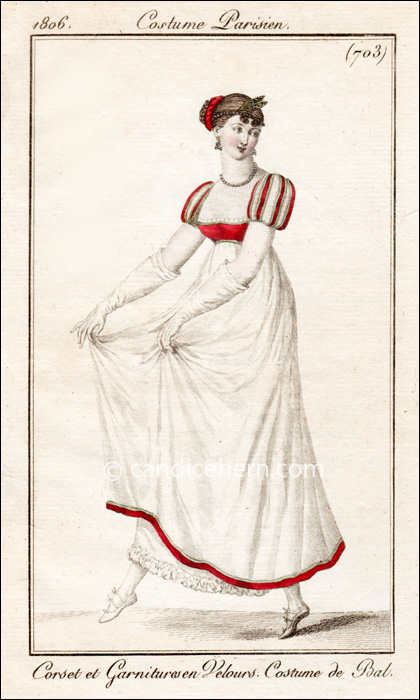
French prints of ball dresses often depicted the model in the act of dancing, to better show the movement of the dress. Here, in the steps of the dance, she lifts the skirt of the over dress, giving us a view of the under dress with its ruffled trim.
In both French and English prints, ball dresses are often shown with short hems, the better to show off the elegant dancing slippers. Whether or not the actual dresses had such short hems is questionable, especially in this early period when hems in general were still quite long.
We do not know the fabric of this dress (it is not described in the magazine text, only in the caption at the bottom of the print), so it might have been a high-quality muslin or even satin. We do know that the bodice (cut very low) and all the red trim is of velvet. The full short sleeves have the look of a slashed sleeve, but it appears that the red velvet ribbon is simply applied over the white sleeve. In any case, it’s a lovely effect.
The hair is confined in the back with red ribbon, and an arrow-shaped ornament is tucked unto a tightly braided strand in front. Gem-set or paste-set arrows were often worn as hair ornaments. An obvious reference to Cupid’s dart, these hair ornaments became popular in the early 1700s, and had something of a revival in late 1790s through early 1800s.
The gloves are loose, in the English style, and the white slippers have a bow at the top of the vamp, and two ribbons tied in bows across the instep.