Ackermann’s Repository of Arts, July 1811.
“Opera Dress.”
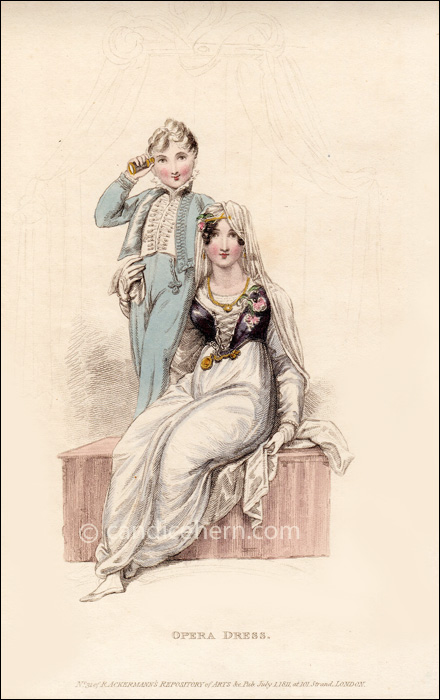
In its first few years of publication, Ackermann included children in several of his fashion prints. I suspect that is because he understood his primary audience was the young married woman. But for some reason, after December 1812, we see no more children. Perhaps by that time he had discovered that the young married women in his audience were more interested in their own fashion than that of their children.
In this print, the young boy is very dressed up and, unlike other prints with children, his outfit is described in detail. There is a faint line drawing in the background that looks like it might be an opera box. So, it appears this youngster accompanied his mother to the opera. It seems like that might be somewhat unusual, but perhaps it was for a performance especially meant to appeal to children.
Boys were “breeched,” that is given their first pair of trousers or breeches, around age 10. As this boy is wearing trousers, he is likely 10-12 years-old, old enough, apparently, to attend the opera or a concert with his mother.
The colors in this print don’t match the description, though every copy of this print I’ve seen is colored as this one. The boy’s suit is said to be gray, but is painted blue. The lady’s dress is described as imperial violet but is left unpainted. No color is mentioned for her vest or bodice, but it is painted a dark purple, ie imperial violet.
The print is described in the magazine as follows:
“OPERA DRESS. A round robe of imperial violet net-crape, or leno, with a long sleeve of the same, worn over a white satin under-dress. A cottage vest, or boddice, of Chinese crape, tabinet, or satin, laced and tagged with correspondent cord and tassels. Under-dress shading closely to the bosom and shoulders. A large unella veil. confined in front with a gold tiara, and a simple rose on one side, flowing in negligent folds over the rear of the figure. Neck-chain and bracelets of finely carved amber, or oriental elastic gold. French repeating watch, with elastic gold chain and seals. Bouquet on the left side of the bosom. White satin slippers, and gloves of white kid.
“YOUTH’S DRESS. A jacket and trousers à la militaire, or Windsor grey cloth. White Marseilles dimity waistcoat, ornamented to correspond; a collar and frill in the antique style; hair a waxed crop. The pomposo, or Moorish half-boot, or yellow or black Morocco. This latter dress was furnished by Mr. S. Clark, No. 37, Golden-square.”