Ackermann’s Repository of Arts, January 1816.
“Evening Dress.”
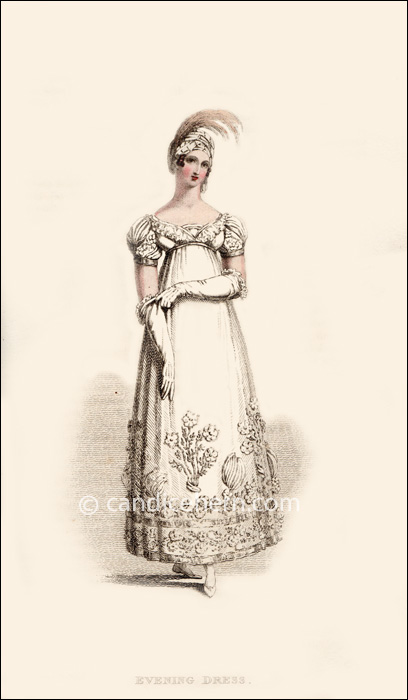
By 1816, waistlines are very high and the skirts are beginning to show the bell shape that will dominate the next 10 years or so. Hemlines, at least for evening dress, are a bit shorter, showing a bit of ankle. The elaborate decoration of this skirt looks a bit fussy, but it is all made of silver lamé, so must have been pretty spectacular in person, especially in candlelight.
It is interesting that this dress is described as also being appropriate as a ball dress, but without the turban and feathers. I suppose one wouldn’t want tall feathers bouncing around as one danced.
The print is described in the magazine as follows:
“A white crape frock over a satin slip; the frock is superbly ornamented with French Lama work in silver; the dress is cut very low all round the bosom, and the crape fronts are open at each side, so as to display the white satin one underneath. The sleeve is an intermixture of white satin and crape; the latter full, the former tastefully ornamented with silver, to correspond with the bottom of the dress. Head-dress, a white crape turban, ornamented with silver and a long white feather. Necklace and ear-rings or pearl. White kid gloves, drawn nearly to the elbow, and finished at the top with a quilling of tull. White satin slippers. This frock is also in high estimation for a ball-dress, with the hair full-dressed and pearl ornaments, or a comb composed of pearl and coloured gems.
“We are indebted to the tasteful fancy of Mrs. Bean, of Albemarle-street, for both our dresses this month.”
Mrs. Charlotte Bean started out as a milliner in 1806, but soon expanded her business to include dressmaking. She specialized in evening dresses and court dresses. In 1816 she was one of two modistes who made dresses and pelisses for Princess Charlotte’s wedding trousseau.