La Belle Assemblée, November 1813.
“Morning & Dinner Dresses.”
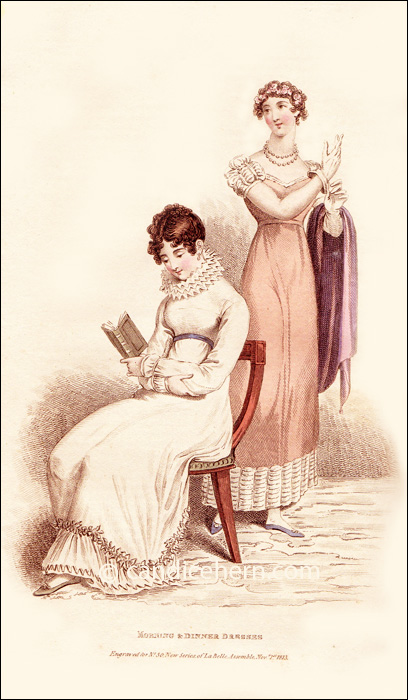
I love the simplicity of this Morning Dress. It’s very pretty and comfortable looking, perfect for an at-home dress.
This is the very first instance of a Dinner Dress I have seen in my large collection of fashion prints. I had thought that category came to life in 1814, when it is frequently seen, but here it is in November of 1813. I remain convinced that a new category of dress was created to encourage dressmakers’ clientele that they really did need a special type of dress for dinner parties. It is possible that Mrs. Bell, who was in charge of the fashion pages of La Belle Assemblée at this time, came up with the idea. In the March 1813 issue, the description of a Half Dress says that it is “general for dinner parties,” and in the two months previous to this print, Mrs. Bell had mentioned dinner dresses in her fashion commentary. But this is the first print that names a Dinner Dress in its title. Mrs. Bell did not open her own dressmaking salon until February 1814, and almost all of the 1814 prints titled “Dinner Dress,” all of them in this magazine, were designed by her. By 1815, other magazines began to use the Dinner Dress title in fashion prints, with dresses designed by other modistes. It was now a regular marketing category, along with Afternoon Dress, Opera Dress, etc.
The print is described in the magazine as follows:
“No. 1.–MORNING DRESS. Round dress of jaconet muslin made up to the throat, and buttoned down the back, which is still broader than they were worn last month; the waist is also a little, but it is very little, shorter than they were then. Long sleeve, which falls much off the shoulder; it is very large and loose, and fastens tightly at the wrist by a letting in of lace; the sleeve descends almost to the fingers and is edged with lace. The trimming of this dress is extremely elegant; a very broad flounce, of the same material as the dress, is surmounted by a rich embroidery in coloured silks, and a slight border, the pattern a wave, goes round it at the bottom. Treble ruff of pointed lace. Hair cropped behind, and dressed in loose full curls in front. Ear-rings of dead gold in the shape of a heart; they are very small. Slippers of slate coloured kid, made much higher round the instep than they have been worn for some time, and trimmed with a ribband to correspond.
“No. 2.–DINNER DRESS. Frock of Devonshire brown crape, made to display the back, bosom, and shoulders as much as possible. This exquisitely simple and becoming dress leaves us little to describe: in the form of the frock there is nothing new, but the trimming, which is of white satin, is very novel and tasteful; it is laid on in folds, which are separated into small compartments by strings of real pearl. The sleeve, which is of white satin, corresponds with the flounce. Hair partly twisted up behind, partly descending in loose ringlets on the back of the neck; the forehead is shaded by a few loose and beautiful ringlets; a wreath of half-blown roses is put on rather to one side, and the whole air of the head is as youthful as possible. Pearl necklace, ear-rings, and bracelets. White kid slippers with silver rosettes. A rich scarf of lemon colour shot with lilac [painted here, and in every other copy of this print I’ve seen, in dark pink] is occasionally thrown over the shoulders; and a ridicule with silver clasps and tassels, finished the dress.”