La Belle Assemblée, November 1811.
“Morning Walking Dress.”
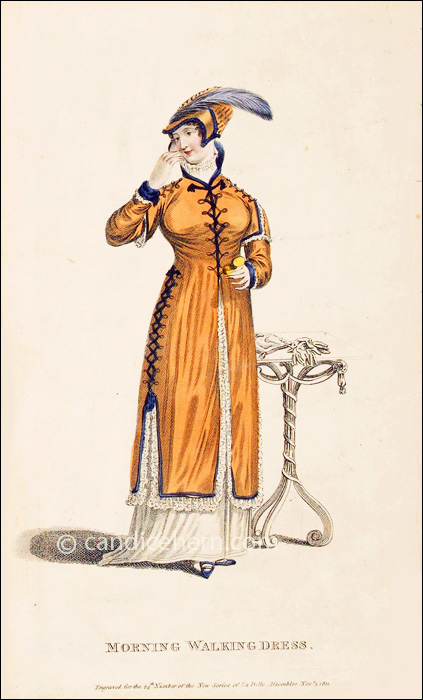
During 1811 we see several examples of lower waists for all types of garments. It is not consistent, but these lower waistlines show up often enough to suggest that some designers were thinking it was time to bring the waist back down toward its natural place. These experiments did not take, as the high waist was consistently back in fashion in 1812, and it continued to rise higher and higher until it did indeed begin to creep down toward the natural waist in the early 1820s.
In this case, the lower waistline with the full bosom is not the most flattering style. Along with the strange bonnet, this ensemble comes very close to being a fashion disaster.
The amber pelisse trimmed with purple is an interesting color combination, but it works.
The description of this print is extremely detailed. Along with a much longer and more comprehensive General Observations on Fashion and Dress compared to previous months, we can probably assume that this is the month in which Mary Ann Bell took over the fashion section of La Belle Assemblée. She had performed a similar role in her husband’s now defunct magazine, Le Beau Monde, and perhaps her father-in-law, the publisher of this magazine, thought Mrs. Bell would add a needed liveliness to the fashion department. She reigned supreme in that department for the next 20 years.
The print is described in the magazine as follows:
“PROMENADE OR CARRIAGE COSTUME. A fawn colour or amber velvet three quarters pelisse; faced and ornamented round the bottom and sleeves with Regency purple velvet, and laced down the waist, shoulders, and half way down the sides of the skirt, with rich cordons of purple, terminating with a tassel: a purple velvet collar stands up, is rounded behind, and comes down to a point below the throat: the cuffs are of purple velvet, trimmed with fine white lace. Over the sleeve is a demi-sleeve divided; between the division small purple ornaments, in the form of aiguillettes, but without the tags, are sometimes introduced when this dress is made of twilled sarsnet instead of velvet. The pelisse is trimmed all round, and up that part of the sides which are not laced with the cordon, with white French lace; and worn over an high dress of fine jaconet muslin, with a demi-train: the dress is made something in the chemisette form, with a single lace ruff. A Queen Mary’s bonnet of the same colour and materials as the pelisse, trimmed round the edge with quilled ribband of purple satin, or rich fancy trimming of silk; and surmounted by a long flat ostrich feather of purple, turned from the face, half dropping toward the crown, which is puckered, and of a conic form. A gold watch is worn on the outside of the pelisse, with small gold chain, and very little ornament. Ridicule of fawn colour or amber, with purple strings and tassels; purple kid gloves, and demi-broquins, or quarter boots of the same.”
In the General Observations on Fashion and Dress is the following statement:
“… the figure represented in our present number displays an exact copy of a costume which was given us, and which has been just completed for a lady who ranks high in fashionable life.”