Bookshelf
Coming Soon
Meet Candice
Candice's Collections
Blog
For Reviewers & Booksellers
Contest
Readers Ask
An illustrated glossary of Regency terms and phrases
Regency fashion prints and accessories from Candice's Collections
Historical figures from the Regency
Famous sites from the Regency
See what certain Regency sites look like today
Research links to lots of Regency and Georgian sites
Regency research topics from the Discussion Board

WELCOME TO CANDICE'S REGENCY WORLD

The English Regency, in its most literal interpretation, encompasses the years 1811 to 1820. It was the time during which the Prince of Wales (who later ruled as George IV) served as Regent while his father George III was so mentally unbalanced as to be unable to serve as monarch. In its broader interpretation -- when used to describe periods of art, literature, fashion, design, and architecture -- the Regency can encompass years as early as 1790 and as late as 1830.
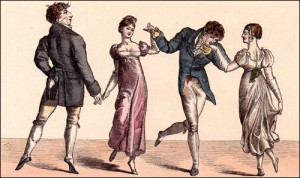
The Regency as a setting for romance is appealing in great part due to the rich dichotomy of Society vs. history, the real world vs. the oblivous aristocratic fantasy world. It is that small, glittering, elegant world seemingly insulated from the horrors of the Napoleonic Wars, the beginnings of political, social, and agricultural reform, and the onset of the industrial revolution that provides a very real and complex backdrop for Candice's novels. While the war ravaged the Continent and affected most English families through the loss of sons, husbands, fathers, brothers, and uncles, and while the Luddites rioted against industrialization, Society persevered in its elegant finery at balls and routs and parties of all kinds.

The leader of this elite, fashionable society was the Prince Regent himself, who was a fat, pleasure-seeking womanizer, self-indulgent almost to the point of hedonism. He was also one of the best educated monarchs England has ever seen. He was a major supporter of the arts, and the scope of his interests (and extravagant spending) included architecture, painting, music, and fashion.

This rich context of early 19th century England is also the world of Jane Austen, who lived in and wrote about Regency England. Her literary legacy lives on in books written by Candice and other historical romance novelists. You are invited to use this page and its links to learn more about the Regency World -- the people, the places, the fashion, the language, and more.

NEW items in the Regency Glossary:

Other Resources at candicehern.com:


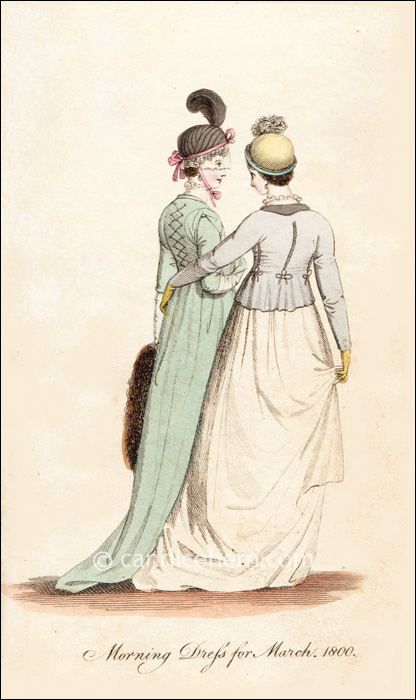
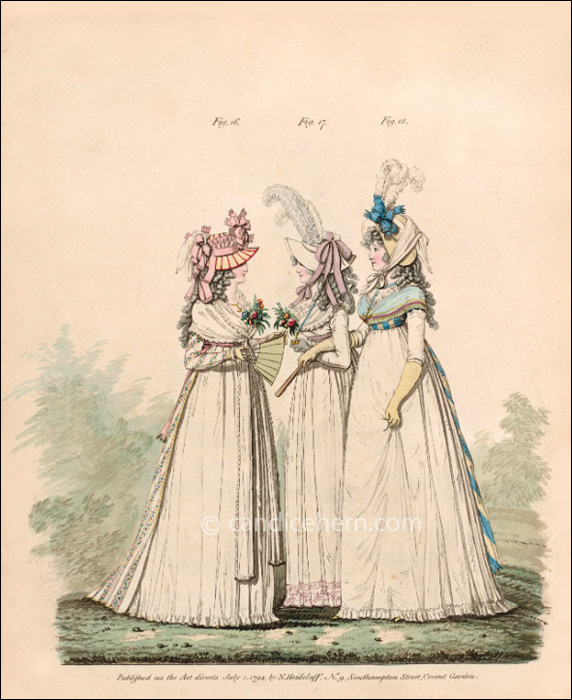
Learn about fashions and accessories of the Regency period through these articles from Candice's Collections:

Evening Dresses 1801 - 1818

Watch how the style of dress changes from year to year -- the hem lengths, the trains, the flounces, etc. This article was the first of the fashion print articles and so explains a bit about the fashion magazines of the day. Read more ...

Walking Dresses 1806 - 1812

Fashion prints from some of the popular ladies' magazines of the period are used to illustrate walking dresses of the period. Learn what type of costume was termed a walking dress, what materials were used, and how they were trimmed and decorated. Read more ...

Walking Dresses 1813 - 1815

More fashion prints from the magazines are used to show the evolution of style for the walking dress. Even in the Regency, fashion changed from year to year. Read more ...

Walking Dresses 1816 - 1818

In the final article on the walking dress, you will see changes in the shape of the skirt and an increase in ornamentation, as the end of the decade approaches and the era of fashionable excess begins. Read more ...

Riding Habits 1799 - 1817

These distinctive equestrian costumes had to accommodate riding sidesaddle. Did you know that during the Regency, riding habits were always created by a man's tailor and never by the lady's dressmaker? Read more ...

Court Dresses 1804 - 1822

Very specific rules governed what both men and women wore to court. The rules, unfortunately, did not change with the dress styles, so that women still had to wear hoops even though they looked silly with the high-waisted dresses. Read more ...

Regency Beaded Sovereign Purses

Sovereign purses were tiny coin purses that were often tucked inside a larger reticule, or sometimes hung on a chatelaine at the waist. These examples are beaded. Read more ...

Regency Knitted and Netted Sovereign Purses

More coin purses, but this time either knitted or netted. These tiny purses were often made by the ladies who wore them. Netting was an especially popular craft for ladies. Read more ...

Georgian and Regency Miser Purses

These purses were used by both men and women. Sometimes called long purses or stocking purses, they were easy to make and therefore widely popular. Read more ...

Georgian and Regency Sentimental Jewelry

Sentimental jewelry was worn to express affection, loyalty, devotion, or grief. It can be a ring, brooch, pendant, or any other type of jewelry and is often composed of or decorated with very specific, almost codified, symbols and devices. Read more ...

Lover's Eyes

These unusual pieces were a variation of the portrait miniature, with the painting of only the eye. Their original intent may have been to disguise identity, so that one could wear a picture of one's secret lover without revealing his or her face. The lover's eye had a very short period of popularity and are therefore somewhat rare. Read more ...

Quizzing Glasses

You've read about the arrogant hero glaring through his quizzing glass when he wants to put someone in his or her place. See what these items, essential to the dandy, looked like. Read more ...

Lace Pins

These tiny brooches were used to keep lace pinned in place. This particular collection features lace pins with woven hair under glass. Read more ...

top


Real historical figures of the late 18th and early 19th centuries make cameo appearances, or are briefly mentioned, from time to time in Regency-set romances by Candice and others. The following section includes brief information on some of those people readers may encounter :

(Note: the following information is not comprehensive and is only meant as a quick reference for readers.)

The Royal Circle

The Prince Regent (1762 - 1830)

George, Prince of Wales, (often referred to as Prinny) was the eldest son of George III, and was named Prince Regent when his father became too mentally unstable to rule. His regency, 1811-1820, gives name to the period. He reigned as George IV from 1820 to 1830. Both his regency and his monarchy were marked by fiscal extravagance. His education and taste served to label him one of the most accomplished men of his age, yet his self-indulgence was seen as a waste of his talents. Overweight, overdressed, and oversexed, he was not popular with his subjects. His cultural achievements, however, cannot be denied. No other member of the Royal Family has ever been such a staunch supporter of art, architecture, music, and science. His many legacies include Regent's Park and the National Portrait Gallery. Upon his death, the Duke of Wellington said that George IV had been "the most extraordinary compound of talent, wit, buffoonery, obstinacy, and good feeling -- in short a medley of the most opposite qualities, with a great preponderance of good -- that I ever saw in any character in my life."

Caroline, the Princess of Wales (1768 - 1821)

Caroline of Brunswick was the first cousin and troublesome wife of the Prince of Wales. Theirs was, of course, an arranged marriage, and the prince hated her on sight. They each found the other unattractive and are reputed to have spent only two nights together, during which they conceived a daughter, and never slept together again. There was much scandal about Caroline's purported infidelities, including an investigation into whether a young boy living with her was her illegitimate son. It was never proven, and both she and the prince continued to openly flaunt their love affairs. Caroline left England in 1814, living abroad and behaving as she pleased with whom she pleased. When her husband finally became king, she returned to England, only to face an ugly parliamentary proceeding to strip her of her crown and dissolve her marriage. She was barred from attending her husband's coronation and died 3 weeks later.

Princess Charlotte (1796 - 1817)

The only child of the Prince and Princess of Wales, Charlotte was second-in-line to the throne after her father and would have ruled as Queen Charlotte I had she lived. Her early death in childbed in 1817 set off a royal family crisis: King George III had 12 living children but no living grandchildren. (His six sons had a multitude of illegitimate offspring, however.) Though they were all by then in their 40s and 50s, the rest of the king's sons began a race to produce heirs. The Duke of Kent won the day. He dropped his faithful mistress of 27 years, married in 1818, and sired a daughter. She would rule as Queen Victoria.

Mrs. Fitzherbert (1756 - 1837)

A Catholic widow, Maria Anne Fitzherbert was married to George, Prince of Wales in 1785, though the marriage was considered invalid under the Royal Marriages Act of 1772 because the king had not approved it. The young prince had known his father would not approve because Maria was a Roman Catholic, but he married her in secret, supposedly because she refused to be his mistress. There are many who believe they had at least one child together, but it has never been proven. Through all his mistresses and love affairs, the prince always seemed to return to Maria as his one true love, though their relationship came to a permanent end in 1811 when he snubbed her at a grand fête given at Carlton House to celebrate his new role as Regent. They never lived together again, but when King George IV died in 1830, he was wearing her miniature portrait around his neck, and was buried with it.


Leaders of Society and the Demimonde

Beau Brummell (1778 - 1840)

George Bryan Brummell, known as the Beau, was the most important arbiter of fashion during the Regency. He rose to the highest levels of society despite an unimpressive ancestry (his grandfather had been a shopkeeper, his father a private secretary to Lord North) through his good looks, impeccable style, keen wit, and elegant manners. He became a friend of the Prince of Wales when still a teenager, and was only 16 when he stood up with the prince at his disastrous wedding to Caroline of Brunswick. He was the leader of the dandy set, establishing the style in men's fashion for understated elegance and beautiful tailoring. Arrogance and reckless extravagance led to his downfall. He had fallen out of favor with the prince by 1813, and fled England in 1816 when his debts became too large. He settled in France, first in Calais then in Caen, where he died destitute and demented in an asylum, a victim of syphilis.

Lord Alvanley (1789 - 1849)

Regarded by some as the wittiest man of his day and a dandy to rival Brummell, the 2nd Baron Alvanley was a popuar member of the Prince of Wales' circle. He was a bruising rider to hounds, a fine sportsman, and a famous host of exclusive dinner parties. He was one of the hosts of the 1813 ball where Brummell, after being cut by the Prince, addressed to Alvanley the infamous remark "Ah, Alvanley, who is your fat friend?" Like most of the dandy set, he loved to gamble, and lost most of his family's property to gambling debts. Even so, he was perpetually good-humored and sharp-witted, and, according to Captain Gronow, "was awarded the reputation, good or bad, of all the witticisms in the clubs after the abdication of the throne of dandyism by Brummell who, before that time, was always quoted as the sayer of good things."
Lord Alvanley makes very brief appearances in two of Candice's books, In the Thrill of the Night and An Affair of Honor.

Lady Jersey (1786 - 1867)

Lady Sarah Sophia Fane, daughter of the Earl of Westmoreland, married the 5th Earl of Jersey and became a leader of London society as a patroness of Almack's Assembly Rooms. The young Lady Jersey of Almack's fame is not to be confused with her mother-in-law, Frances, Lady Jersey, wife of the 4th Earl of Jersey, who was mistress to the Prince of Wales. (Prinny obviously preferred older women.) Sarah, sometimes called Sally, was determined, through a great show of personal virtue, to distance herself from the notorious reputation of her mother-in-law. Captain Gronow described her in his memoirs as "a threatrical tragedy queen; and whilst attempting the sublime, she frequently made herself simply ridiculous, being inconceivably rude, and her manner often ill-bred." She is reported to have introduced the quadrille to Almack's in 1815.

Emily Cowper (1787 - 1869)

The daughter of the infamous Lady Melbourne, Emily was married to the 5th Earl Cowper. She was also the long-time mistress of Lord Palmerston and married him in 1839 after Cowper died. During the Regency years, she was one of the patronesses of Almack's Assembly Rooms and, according to Captain Gronow, the most popular of them. It should be noted that Lady Cowper and most of the other patronesses at that time were young women in their 20s and not the older dowagers some readers assume them to be. They wielded enormous social influence.

Countess Lieven (1785 - 1857)

Born in Latvia, Dorothea Benckendorff married Count Lieven, who was the Russian ambassador to England from 1812 to 1834. The countess immediately became a leader in London society, and by 1814, if not earlier, was elected one of the patronesses of Almack's Assembly Rooms, the first foreigner to be so honored. Gronow described as her "haughty and exclusive," though she is said to have introduced the German Waltz to Almack's. But she was much more than a social butterfly. The countess was a prominent political hostess and held the confidence of some of the most important statesmen in London and Europe. She was considered to be at least as politically important, if not more so, than her ambassador husband. Hers was an influential voice in diplomatic circles, and she even performed at least one secret diplomatic mission for the Tsar. Some time after leaving England, the count was made a Prince and Dorothea became the Princess Lieven. Though she suffered from ill health in the last decades of her life, she continued to be involved in politics and diplomacy. Her collected letters provide a wickedly gossipy insight into Regency England.

Mrs. Drummond-Burrell (1786 - 1865)

Clementina Drummond-Burrell was the only surviving child of James Drummond, 11th Earl of Perth. She married Peter Robert Burrell, a great dandy of the day, in 1807. On his marriage, at his father-in-law's insistence, he joined his wife's family name to his. His father had been created Lord Gwydyr, and in 1820 he succeeded to that title; his mother was Lady Willoughby de Eresby in her own right, and in 1828 he also succeeded to this title, and Clementina became Lady Willoughby de Eresby. One of the young patroness of Almack's, she was considered, along with Lady Castlereagh, to be the highest stickler and overly grand.
Mrs. Drummond Burrell attends one of Grace's "at home" afternoons in Lady Be Bad.

Lady Castlereagh (1772 - 1829)

Amelia Anne Stewart, Viscountess Castlereagh, was another of the lady patronesses of Almack's. She was the wife of Lord Castlereagh, the unpopular Foreign Minister, and accompanied him to the Congress of Vienna in 1815. A stickler for propriety, she is credited with establishing the rule that closed the doors of Almack's precisely at 11:00pm, and is reported to have once turned away the Duke of Wellington when he arrived a few minutes late. Though one of the older patronesses, she is unlikely to have been elected to the position prior to 1812 when her husband became Foreign Secretary.

Lady Sefton (1769 - 1851)

Born Maria Margaret Craven, she married the 2nd Earl of Sefton in 1792. Her husband was known as Lord Dashalong because of his fondness for fast driving. He was one of the founding members of the Four-In-Hand Club. Lady Sefton was one of the Lady Patronesses of Almack's. The eldest of the 1814 patronesses as reported by Captain Gronow, she had likely held that position well before the younger set came on board as both she and her husband were socially prominent. She sponsored Mrs. Fitzherbert in London society.

Princess Esterhazy (1794 - ?)

Princess Esterhazy was born Princess Theresa of Thurn and Taxis and married Prince Paul III Anton Esterhazy, the Austrian Ambassador to England. Princess Lieven described her as "small, round, black, animated, and somewhat spiteful" and "she must at all cost be the focus of interest and general attention." As the youngest of the 1814 Lady Patronesses of Almack's, she was called by Gronow a bon enfant. Her husband was made Ambassador to the Court of St. James in 1815, but he and the princess must have been in London in some other diplomatic role prior to that if, as Gronow reports, she was already established at Almack's as a patroness in 1814.

Caroline Lamb (1785 - 1828)

Lady Caroline Ponsonby was the daughter of the Earl (and the notorious Countess) of Bessborough, and grew up in the household of her equally scandalous relatives, the Duke and Duchess of Devonshire. She was educated there with her three legitimate cousins and two illegitimate cousins (daughters of the duke and Elizabeth Foster). Caroline was married at 19 to William Lamb, heir to Viscount Melbourne. Though happy at first, their marriage fell apart after the death of two children and the promiscuity of Lamb. In 1812 she embarked on the infamous affair with Lord Byron. It was Caroline who said about him that he was "mad, bad, and dangerous to know." In 1816 she published anonymously the novel Glenarvon, a thinly-disguised account of her affair with Byron that also skewered many prominent members of the ton. In 1824 she suffered a nervous breakdown that apparently led to dementia. She removed to the Melbourne country estate, Brocket Hall, and died there in 1828. That same year, her estranged husband succeeded to the title Lord Melbourne, and later became prime minister of England.

Harriet Wilson (1786 - 1846)

An infamous courtesan who took London by storm with her sisters Amy and Sophia, Harriet was the daughter of a humble Swiss clock maker. By the age of 15, she had already elevated herself as the mistress of the Earl of Craven. When that liaison ended, she took up with the Duke of Argyll, who also had an affair with her sister, Amy. The young Marquess of Worcester wanted to marry Harriet, but his father, the Duke of Beaufort, paid her off and sent his son to Spain. When Harriet broke the terms of her agreement by writing to Worcester, the duke cut off her funds and, good business woman that she was, Harriet threatened to sue him. Some of her other "clients" were said to include the Prince Regent, Wellington, and Lord Palmerston. At 40, she published a tell-all autobiography that named names. Prior to publication, thinking to make more money by NOT publishing it, she and her publisher made sure to circulate drafts to several of the important men mentioned in the book, suggesting that for a sizable donation, she would agree to omit passages in which they were mentioned. It is said that over 200 letters were sent to former clients, asking for an annual annuity of £20, or a lump sum of £200 to keep their names out of her memoirs. Wellington is famously said to have replied, "Publish and be damned." Others, including, some say, George IV, paid up. Harriet's memoirs, published in 1825, were a bestseller, even though much of it was known to be completely fictional.

Emma Hamilton (1765 - 1815)

Born Amy Lyons, the daughter of a blacksmith, she later changed her name to Emma Hart when she entered the world of prostitution in London. Her beauty made her famous, and she became the mistress of several men over the years, as well as the favorite model for the artist George Romney. She lived for a time with Charles Greville, younger son of the Earl of Warwick, who was in love with her. But he needed to marry a rich wife and sent Emma to Naples in 1786 to be mistress to his uncle, Sir William Hamilton, who was the British envoy. Hamilton surprised everyone by marrying Emma in 1791. When Horatio, Lord Nelson came to Naples a hero in 1798, after the Battle of the Nile, Emma became his mistress. Hamilton, by then quite elderly, apparently tolerated the affair; some say he even encouraged it. In 1801, Emma gave birth to Nelson's daughter, named Horatia, at Hamilton's town house in London. Shortly afterward, Nelson bought a house in Merton where he, Emma, Hamilton, their "adopted" daughter Horatia, and Emma's mother lived together. Hamilton died in 1803, the same year Nelson returned to active naval duty, leaving Emma behind, pregnant with their second child, who did not survive. Nelson died in 1805 and left instructions for the government to provide for Emma and Horatia. His wishes were ignored, and Emma fell deeply in debt. She spent a year in debtor's prison before escaping her creditors by moving to France. She died penniless in 1815 in Calais.


Leaders in Politics, the Military, and Social Reform

William Pitt, the Younger (1759 - 1806)

The youngest Prime Minister in Britain's history, Pitt was only 24 when he first took office and remained Prime Minister for a total of 19 years over two administrations. (His father, William Pitt the Elder, had also been Prime Minister.) He held Tory views but considered himself an independent Whig. He championed Parliamentary reform, the Act of Union with Ireland, Catholic emancipation, abolition of the slave trade, and reduction of the national debt. His views changed after the Reign of Terror in France (he declared war on France in 1793) and, afraid of similar revolt in England, he cracked down on sedition and reform, suspending habeus corpus more than once. He resigned in protest in 1801, shortly after securing the Act of Union, when he learned the king had approached the anti-emancipation Addington to be prime minister. He accepted the king's request to return to office in 1804 when there was fear of a French invasion. His prosecution of the war paved the way for Nelson's victory at Trafalgar. Pitt died at 46 from liver disease caused by alcoholism. He never married and died heavily in debt.

Lord Castlereagh (1769 - 1822)

Robert Stewart, Viscount Castlereagh, was son of the Irish peer, the Marquess of Londonderry, whose title he inherited as the 2nd Marquess in 1821. He held minor positions in the Pitt and Addington governments and was Secretary of War under Lord Portland. In 1809 he fought a duel with the Foreign Secretary, George Canning, and both were forced to resign their positions. He returned to the government in 1812 as Foreign Secretary, a post he held for ten years. He was instrumental in negotiations for the Treaty of Paris and represented Britain at the Congress of Vienna after the Napoleonic Wars. He was very unpopular, which apparently led to an extreme state of paranoia. He committed suicide by slitting his throat in 1822. His wife was one of the Lady Patronesses of Almack's.

Lord Liverpool (1770 -1828)

Robert Jenkinson, 2nd Earl of Liverpool, was appointed Prime Minister after the assassination of Spencer Perceval in 1812. He held the office for 15 years, throughout most of the Regency and reign of George IV. He was a skilled politician and negotiator. The end of the Napoleonic Wars in 1815 was followed by a period of social unrest culminating in the Corn Law Riots and the Peterloo Massacre in 1819. Liverpool's government reacted with the Six Acts, which cracked down on the radical press and large meetings of any group, in hopes of preventing armed insurrection.

Lord Nelson (1758 - 1805)

Horatio Nelson, 1st Viscount Nelson, is considered to be the greatest naval hero in the history of England. Son of a vicar, Nelson went to sea with the Royal Navy as a midshipman at the age of 13. He quickly made his way up the ranks, distinguishing himself by bold action and clever strategy, eventually being named Rear Admiral in 1797 after the Battle of Cape St. Vincent. He lost his right arm that same year (and had lost the sight in his right eye in 1794), but that did not impede his success at the Battle of the Nile in 1798, a victory which earned the him the title Baron Nelson of the Nile. He had married Fanny Nesbit in 1787, but rather callously cast her aside for Lady Hamilton in 1798. He was created Viscount Nelson in 1801 after another important victory, the Battle of Copenhagen. Napoleon began amassing forces to invade England, and to stop him, Nelson was made commander-in-chief of the Mediterranean in 1803. He was killed at the Battle of Trafalagar in 1805, a decisive victory which ensured British naval supremacy for the remainder of the war. To date, Nelson is one of only five non-royals to receive a state funeral in Britain.

Duke of Wellington (1769 - 1852)

Arthur Wellesley was born in Ireland, a younger son of the Earl of Mornington. (The original family name was Wesley, but the spelling was changed in 1798.) He was something of a rake as a young man, and was sent by his mother and eldest brother into the army to "straighten him out." There, he found his calling, immersing himself in the study of military science as he had never done at school, ultimately becoming one of the greatest generals in British history. He served in India, where he rose to the rank of major-general, and never lost a battle. In 1809, he was sent to the Iberian Peninsula to defend Portugal against Napoleon. He became Viscount Wellington after the Battle of Talavera that same year and was made General in 1811. After several successful sieges in Spain in 1812, he became the Earl of Wellington. Later that same year, after the Battle of Salamanca, he was elevated to Marquess of Wellington. Finally, after the Battle of Toulouse and the abdication of Napoleon in 1814, he became the Duke of Wellington. He was serving as British Plenipotentiary at the Congress of Vienna when Napoleon escaped Elba and landed again in France. Wellington assembled an allied army in Brussels, ultimately defeating Napoleon at Waterloo in 1815. He later served as prime minister.
Richard attends a ball in honor of the new Duke of Wellington in Her Scandalous Affair.

William Wilberforce (1759 - 1833)

Politician and philanthropist, Wilberforce is best known for leading the British campaign against the slave trade. Following the lead of his politically-minded friend William Pitt the Younger, he was first elected to Parliament at 21 as an independent Tory. He led many campaigns over the years: for parliamentary reform on the one hand, against trade unions on the other. His faith led him to head the campaign to abolish the slave trade, and he introduced the first parliamentary bill to do so in 1791. It did not pass then, nor when he introduced similar bills in 1792 and 1793. Even while the government was preoccupied with events in France after the Reign of Terror in 1793 and was skittish of any social reform, Wilberforce kept introducing annual motions in favor of abolition. Finally, in 1805, an abolition bill was passed in the House of Commons, but it failed in the House of Lords. In 1807, with the help of Whig abolitionists, including Fox and Grenville, Wilberforce was able to get a bill passed through both houses that prohibited British subjects from aiding or participating in the slave trade, ie no British ships could carry slaves from that point forward. Wilberforce retired from Parliament due to ill health in 1821. He died in 1833, one month before Parliament passed the Slavery Abolition Act, which freed all slaves in the British Empire.


Stars of the Stage

Mrs. Jordon (1761 - 1816)

Born Dorothea Bland, she assumed the name of Mrs. Jordan when she became an actress. (There was no Mr. Jordan; she never married. It was a convention of actresses of the day to take on a married name as it was deemed more respectable.) A star at Drury Lane for almost 30 years, she was a great comedienne who was renowned for playing "breeches" roles, i.e. young men, or girls disguised as boys. Dora was a beautiful woman who attracted the interest of many important gentlemen. She bore 13 children, 10 to the Duke of Clarence, whose mistress she was for over 20 years. Like most of his royal siblings, the duke was constantly in debt, and Dora's earnings on the stage kept the "family" afloat. He abandoned her in 1811 when his family urged him to make a legitimate, royal marriage. Dora died in 1816 in France, penniless and brokenhearted. When the duke became King William IV upon the death of his brother, George IV, one of his first acts was to commission a statue of Dora with two of their children.

Sarah Siddons (1755 - 1831)

Born as Sarah Kemble into a family of actors, she became the greatest tragedienne of the late 18th and early 19th centuries as Mrs. Siddons. (Yes, in her case there was a Mr. Siddons. She married fellow actor William Siddons in 1773. They had seven children, two of whom died in infancy.) She made her Drury Lane debut in 1775 as Portia in The Merchant of Venice, and despite long experience in her father's company, it was a disastrous performance and her contract was not renewed. She honed her craft in provincial companies for the next six years and was an immediate sensation when she returned to Drury Lane in 1782. For the next twenty years, she reigned supreme as the dramatic queen of Drury Lane and became a British cultural icon. She left Drury Lane in 1802 and played at various venues, including the rival Covent Garden Theatre. There, in 1812, she gave her famous farewell speech to a crowd of adoring fans whose applause was so thunderous at her performance of Lady Macbeth that she was not allowed to finish the play. It was her final performance in a play, though she did give occasional readings up until her death in 1831.

John Philip Kemble (1757 - 1823)

Brother to the famous Sarah Siddons, Kemble was an actor whose talent was reputed to be second only to his sister. He joined the company at Drury Lane in 1783 and in 1788 became its manager. Conflict with Sheridan, the owner, led to Kemble's resignation as manager in 1802. The next year, he became manager of Covent Garden. His father died that year, and Kemble took the money he'd inherited and invested it in Covent Garden. When the theatre burned down in 1808, he would have gone bankrupt but for a loan from the Duke of Northumberland. When the rebuilt theatre opened a year later, the higher prices Kemble set to help defray the cost of rebuilding led to the OP (Old Price) riots. The crowd shrieked and yelled and screamed so that the actors on stage could not be heard. This continued for 67 nights until a compromise was made and Kemble made a public apology. He retired from the stage in 1817 due to asthma. He moved to France and then to Switzerland for his health, and died in Lausanne in 1823.

Edmund Kean (1787 - 1833)

The son of an actress, Kean was a troublesome child and eventually went (or was sent) to sea as a cabin boy. He hated it, and showed an early talent as a Thespian when he managed to convince doctors that he was both deaf and lame. As a teenager he made a name for himself in Shakespearean roles at the York Theatre and then in a traveling troupe, and his reputation reached the ears of the king. George III commanded a performance at Windsor Castle. Kean embraced each role with passion, but was short of stature. In 1807 he performed in Belfast with Sarah Siddons, who famously called him "a horrid little man." She ultimately had to acknowledge his talent and said that he "played very, very well, but there is too little of him to make a great actor." His first London appearance, as Shylock at Drury Lane in January 1814, was a resounding success. Various other Shakespearean roles followed, demonstrating his enormous range as an actor and securing his position as the greatest actor of the age. Some say that Kean's success led to Kemble's decision to retire. Kean's life off the stage was colored by licentious and drunkenness. He was charged with adultery with an alderman's wife in a famous divorce case in 1825, after which his own wife left him. He became very unpopular with the public and was frequently booed and pelted with vegetables on stage. His last performance, as Othello (his son Charles Kean played Iago), was at Covent Garden in 1833. He collapsed on stage and died two months later.
Isabel attends a performance of Othello starring Edmund Kean in Her Scandalous Affair.

Angelica Catalani (1780 - 1849)

The famous Italian opera singer was already a huge star when she came to England in 1806, where she reigned as an unrivalled prima donna for seven years. She performed in Paris before coming to London, and Napoleon was so captivated by her voice that he refused to allow her a passport to leave. Determined to honor her London commitments, she disguised herself as a nun and found passage to England. She was an immediate success when she performed at the King's Theatre in Haymarket. In 1812, she performed Susanna in the first London production of Mozart's Le Nozze di Figaro. Journalist and essayist Leigh Hunt described her as "a Roman with the regular Italian antelope face (if I may so call it); large eyes, with a sensitive elegant nose and lively expression." In fact, she was considered quite beautiful, and her rare combination of beauty and talent was often noted. Her voice was a soprano of the purest quality, embracing three octaves, and was described in the press as "full, rich, and magnificent beyond any other voice ever heard." The London public adored her, and she was wined and dined by the highest levels of Society.
Adam and Marianne attend a performance of Le Nozze di Figaro starring Catalani in In the Thrill of the Night.

Joseph Grimaldi (1778 - 1837)

Son of the ballet master at Drury Lane and a ballet dancer, Grimaldi was a celebrated clown and master of the art of pantomime and physical comedy. He owed much in style to the Italian commedia dell'arte of the 17th century, but by putting his own improvisational spin on it, as well as interacting with the audience, he created a whole new style of comedy that is generally accepted as the basis for the modern day clown. By 1806, when he performed at Covent Garden in Harlequin and Mother Goose, he was already known as England's favorite clown. He lampooned everyone from the Prince Regent to Brummell and got away with it. At his death in 1837, the London Illustrated News said, "Grimaldi is dead and has left no peer." His memoirs were edited by Charles Dickens.


Leaders in Literature and the Arts

Lord Byron (1778 - 1824)

George Gordon Byron, 6th Baron Byron of Rochdale (yes, Rochdale!) was one of the great poets of the 19th century. His most important works were the book-length narrative poems, Childe Harold's Pilgrimage (1812) and Don Juan (1819 - 1824). Though he lived in the age of Romanticism, his work was not, strictly speaking, Romantic. His work was more in the classical style of Pope and Dryden, which the Romantics rejected. Byron, in fact, despised the works of Wordsworth, Coleridge, Keats, and other Romantics. Though club-footed, Lord Byron was tall and handsome, and is said to have had a magnetic personality. His unconventional and often flamboyant life sometimes eclipsed his work. Love affairs with Caroline Lamb and others, reports of incest with his half-sister Augusta (a daughter born to her in 1814 is widely to believed to be Byron's child), and hints at homosexuality all helped to secure the public's interest in him. He married in 1815 and fathered a daughter, but his wife left him a year later, circulating rumors of physical and sexual abuse, adultery, and incest. Byron left England shortly afterward in 1816, fleeing his own notoriety. Yet only a few months later, he continued to flout respectability in the infamous summer on Lake Geneva spent with the physician, Dr. Polidori, the poet Shelley and his soon-to-be wife Mary Godwin, and Mary's step-sister Claire Clairmont who became pregnant (or more likely, was already pregnant) with Byron's child. It was during this intimate house party that the group, bored at being kept indoors by incessant rain, decided to dabble in fanstastical fiction. Mary penned the novel Frankenstein, and Dr. Polidori penned The Vampyre, the progenitor of Stoker's Dracula and all subsequent vampire tales. Byron lived in Italy for a while and embarked on a passionate affair with the Countess Guiccioli, who left her husband to be with Byron. But as so often happened, his quicksilver nature soon found him bored with Italy and the countess, and he left for Greece to fight against the Turks in the Greek War of Independence. He died there in 1824 (from illness, not battle injury), and was mourned by the Greeks as a national hero.

John Keats (1795 - 1821)

Though now considered one of the most important of the Romantic poets, in his own time Keats was criticized and his work skewered by the literary periodicals. He did not at first aspire to be a poet. He thought to become an apothecary, and spent almost 5 years as an apothecary's apprentice, then a year at Guy's Hospital, after which he passed the exam to become a Licentiate of the Society of Apothecaries. But during his apprenticeship, he'd been introduced to Spenser's The Faerie Queen, and his love affair with poetry began. By the end of 1816, after applying for membership in the Royal College of Surgery, he was consumed with the fire to compose poems, and gave up his medical career. His first book of poems was published in 1817 and panned by the critics. Endymion was published in 1818, and was roundly criticized. 1819 is called the Great Year by Keats scholars because he produced so much of his best work that year, despite deep depression brought about by negative reviews. That spring and summer, he wrote La Belle Dames San Merci and the famous odes: Ode To a Nightingale, Ode on a Grecian Urn, etc. Finally receiving critical acclaim, he could not enjoy it due to ill health. Both his mother and brother had died of consumption (tuberculosis), and when Keats began to show symptoms, he became obsessed with his own mortality, knowing the disease would kill him. In 1820, he moved to the warmer climate of Italy, but it did not revive his health. He died in Rome in 1821.

Percy Bysshe Shelley (1792 - 1822)

Son of a Member of Parliament, Shelley was educated at Eton and Oxford, but espoused radical social and political views that made him unpopular. He was eventually sent down from Oxford after publishing a pamphlet on atheism. He began writing poetry while at Eton and possibly earlier, and also published his first gothic novel when only 17. Like Byron, Shelley's life tended to overshadow his work. He had very liberal views on free love and open marriage and lived by them, which, combined with his radical politics, caused much of his work to be dismissed until well after his death. In 1811, the 19-year old Shelley eloped to Scotland with his 16-year old girlfriend, Harriet. He tried to set up a ménage à trois by introducing his friend Thomas Jefferson Hogg into their household, but his young wife objected. In 1814, Shelley abandoned Harriet, pregnant with their second child, to run away with 16-year old Mary Wollstonecraft Godwin. In 1816, the two of them, along with Mary's step-sister Claire, visited Byron in Switzerland. The two poets inspired each other and each wrote some of his best work that summer. When the Shelley party returned to England, with Claire pregnant with Byron's child, they were faced with the suicide of Harriet Shelley, who drowned herself in the Serpentine in Hyde Park. Shelley lost custody of his children, who were given into foster care by court order. Two weeks later, Shelley and Mary were married. They returned to Europe in 1818 and lived in various Italian cities for the next four years. During this time some of Shelley's most important works were written, including Prometheus Unbound. In 1821, inspired by the death of Keats, he wrote the elegy Adonais. In 1822, at age 29, Shelley drowned during a storm at sea in his schooner named Don Juan, in homage to Byron. Debates over his death still abound. Was it accidental? Suicidal? Or was he murdered for his politics?

Jane Austen (1775 - 1817)

The novelist whose books were the antecedent of all modern romances, Jane Austen was the daughter of a clergyman and remained a spinster all her life. Though she had been writing since 1789, her first novel was not published until 1811. Sense and Sensibility was published anonymously ("By a Lady"), and her brother Henry financed the publication. The novel was well-received and made a small profit for her publisher. Her second published book, Pride and Prejudice had been written much earlier, in 1796-97, and had been submitted shortly afterward to a different publisher, and rejected without a reading. The success of Sense and Sensibility encouraged her to unearth the older book. It was published in 1813 as written "By the Author of Sense and Sensibility." Mansfield Park was published in 1814, the first original work not based on her earlier writings. Emma came next in 1815, and was dedicated to the Prince Regent, after he gave her permission to do so (which meant she had no choice). She disliked the prince and was not thrilled to be forced to honor him with an effusive dedication. Northanger Abbey (a reworked version of a novel she had written years earlier and shelved) and Persuasion (a newly completely work) were published together after Jane's death in 1817, with a "Biographical Notice" written by her brother in which her identity as the author of the previous four books was revealed for the first time. She died at 41 from what is now suspected to have been Addison's disease. Her novels were only mildly successful in her life, and fell out of print for several decades. Though Scott publicly lauded her during her lifetime, her genius was not widely appreciated until the end of the 19th century. Today, she is recognized as one of the most important authors in the history of English literature. Her works represent a shift in the style of the novel. Omniscient narrative became infused with the point of view of specific characters, giving her books a more intimate feel, and lending her depictions of English country life and people an immediacy that was unique for its time. Language is less formal and constrained than that of her predecessors and many of her contemporaries. In his 1816 review of Emma, Scott cited it as one of "a class of fiction which has arisen almost in our own times, and which draws the characters and incidents introduced more immediately from the current of ordinary life than was permitted by the former rules of the novel", and "copying from nature as she really exists in the common walks of life, and presenting to the reader, instead of the splendid scenes of an imaginary world, a correct and striking representation of that which is daily taking place around him".

Sir Walter Scott (1771 - 1832)

A prolific historical novelist, Scott was, unlike Jane Austen, a widely read and extremely popular author during his own lifetime. His most famous works include Ivanhoe, Rob Roy, and The Lady of the Lake. It might said that Scott invented the modern historical novel. Despite enormous popularity in the early 19th century, his work is viewed less favorably today, often criticized for being ponderous, wordy, and humorless. Scott did, however, play a major role in rehabilitating the perception of Highland culture. (It is worth noting, however, that Scott was a Lowland Scot, and that his re-creations of the Highlands were romantic and fanciful.) His organization of the visit of King George IV to Scotland in 1822 was a pivotal event: it was the first time a British monarch had visited Scotland since 1650. Scott's inclusion of plaided pageantry was to have a lasting influence, by elevating the tartan kilt to become part of Scotland's national identity.

Fanny Burney (1752 - 1840)

Daughter of the famous musician and musicologist, Charles Burney, Frances Burney was a novelist, diarist, and playwright. She wrote four novels, eight plays, one biography, and twenty volumes of journals and letters, almost all of which are still in print. In addition to the critical respect she receives for her own writing, she is recognized as a literary precursor to prominent authors who came after her, including Jane Austen and William Makepeace Thackeray. We know her novels were read by Jane Austen. Candice owns a 1796 first edition of Fanny Burney's Camilla, in which "Miss J. Austen, Steventon" is listed as one of the subscribers. It might also be said that Burney inspired the title of Austen's most popular work. In the final pages of Cecelia: "The whole of this unfortunate business," said Dr. Lyster, "has been the result of PRIDE AND PREJUDICE." (The caps are Ms. Burney's.) Thackery is said to have based his depiction of the Battle of Waterloo in Vanity Fair on the first-person account in Fanny Burney's diaries. Burney's first novel, Evalina, was published anonymously in 1778. When her identity as the author was revealed, she became something of a celebrity as the book was widely praised by Dr. Johnson, Edmund Burke, and others for its unique narrative and comic voice. All of Burney’s novels explore the lives of English aristocrats, and satirize their social pretensions and personal foibles, with an eye to larger questions such as the politics of female identity. In 1786, when she was a spinster of 33, Fanny accepted a position at court as "Second Keeper of the Robes" for Queen Charlotte. Unhappy at court, she requested and received release from her position in 1790 due to ill health. She maintained friendly relationships with the Queen and the Princesses throughout her life. Fanny supported the cause of the French Revolution, and in 1792 became involved with a group of exiled French "Constitutionalists," including General Alexandre D'Arblay, an artillery officer who had been adjutant-general to La Fayette. She married D'Arblay in 1793 when she was 41, and gave birth their son a year later. When her husband was offered a post in Napoleon's government in 1801, Fanny and her son followed him to Paris. When war between England and France resumed in 1802, they were stranded in France, and remained in Europe through the Battle of Waterloo in 1815. Fanny Burney's journals of her time at the English court and in Paris during the Napoleonic Wars offer first-hand accounts of scores of significant political events, including the Battle of Waterloo, and continue to be some of the most intriguing historical resources of the period.

Sir Thomas Lawrence (1769 - 1830)

Lawrence might be considered the visual documentarian of the Regency, as he was one of the most important, and most prolific, portrait painters of the time. With a great deal of natural talent but no formal training, Lawrence was accepted by Sir Joshua Reynolds as a student at the Royal Academy in 1787. He began exhibiting right away and his reputation spread. By 1794 he was a full Royal Academician and principal painter to King George III. By the time he was knighted in 1815, he was the most fashionable portrait painter in England, his subjects including most everyone notable in English society, as well as many of the crowned heads of Europe. From 1820 to his death in 1830, Lawrence was president of the Royal Academy.
Sir Thomas paints a portrait of Isabel in the epilog of Her Scandalous Affair.

Thomas Rowlandson (1756 - 1827)

Another visual documentarian of the age, Rowlandson made his mark as a caricaturist. He was a student at the Royal Academy and in Paris, but never achieved the promise he displayed as a painter, primarily because compulsive gambling took priority over study. He eventually turned to caricature to finance his debts. He worked almost exclusively for Rudolph Ackermann, for whom he produced several series of Dr. Syntax prints (which he designed and engraved himself) as well as engravings for the Microcosm of London, Dance of Life, Dance of Death, and several other books. His caricatures lampooning prominent people and events were extremely popular and his hand-colored engravings and watercolors were to be found in most print-shops during the Regency.
Rowlandson created a caricature of Max and Rosie waltzing at Almack's Miss Lacey's Last Fling .

J. W. W. Turner (1775 - 1851)

A Romantic painter and watercolorist, Turner can be said to have paved the way for Impression with his unique style of painting. He was accepted into the Royal Academy at the age of 14. One of his watercolors was accepted for exhibit a year later in 1790, and his first oil painting was exhibited in 1796. He thereafter exhibited at every annual Royal Academy exhibition for the rest of his life. Turner was eccentric and given to bouts of depression. But his work was recognized for its genius from the beginning of his career. Innovative, bold, and passionate, his work inspired the art critic John Ruskin to describe Turner as the artist who could most "stirringly and truthfully measure the moods of Nature." His distinctive style of painting, in which he used watercolor technique with oil paints, created lightness, fluency, and ephemeral atmospheric effects. It has been suggested that the high levels of ash in the atmosphere during the 1816 "Year Without a Summer," which led to unusually spectacular sunsets during this period, were an inspiration for some of Turner's work. He is often called "the painter of light." His paintings show a savage grandeur, a natural world unmastered by man, evidence of the power of God -- a theme that Romantic artists and poets were exploring in the late 18th and early 19th centuries. The significance of light was to Turner the emanation of God's spirit and this was why he refined the subject matter of his later paintings by leaving out solid objects and detail altogether, concentrating on the play of light on water, the radiance of skies and fires. Although these late paintings appear to be "impressionistic" and therefore a forerunner of the French school, Turner was striving for expression of spirituality in the world rather than delivering an impression of optical phenomena.
Adam was a patron of Turner in In the Thrill of the Night.


Leaders in Science and Industry

Sir Humphry Davy (1778 - 1829)

An important chemist and physicist, Davy became well known due to his experiments with the physiological action of various gases, including laughing gas (nitrous oxide) -- to which he was addicted -- once stating that its properties bestowed all of the benefits of alcohol but was devoid of its flaws. In 1801 he was nominated professor at the Royal Institution of Great Britain and Fellow of the Royal Society, over which he would later preside. His public lectures on electrochemistry were popular during the Regency, often including demonstrations that caused sensitive ladies to faint from fright. He was knighted in 1812, and presented with a medal by Napoleon in 1813.


Sir Joseph Banks (1743 - 1820)

Naturalist and botanist, Banks took part in Cook's first voyage of discovery to the South Pacific, and is credited with introducing many species of plants to the West, including the eucalyptus, mimosa, and acacia trees. He was president of the Royal Society for 41 years. Banks was an informal adviser to King George III on the Royal Botanic Gardens, Kew. He dispatched explorers and botanists to many parts of the world; through these efforts Kew Gardens became arguably the pre-eminent botanical gardens in the world, with many species being introduced to Europe through them.

John MacAdam (1756 - 1836)

MacAdam is credited with changing coach travel by improving roads. He first began experimenting with road construction on his own estate in Scotland. When he was appointed surveyor to the Bristol Turnpike Trust in 1816 he remade the roads under his control with crushed stone bound with gravel on a firm base of large stones. A camber, making the road slightly convex, ensured the rainwater rapidly drained off the road and did not penetrate the foundations. This way of building roads later became known as the Macadamized system. By the end of the 19th century, most of the main roads in Europe were built in this way.

James Watt (1736 - 1819)

A Scottish inventor and engineer, Watt developed improvements for the steam engine, changing it into a source of power that changed the world and brought about the Industrial Revolution. The new steam engine meant that factories were no longer dependent on water power, and therefore could work the year round, and could be located almost anywhere. Higher efficiency engines ultimately led to a revolution in transportation: the steamboat and the locomotive. Watt was said to be a great conversationalist and was much sought after as a dinner guest.


The Sporting Life

Gentleman Jackson (1769 - 1845)

John Jackson was the bare-knuckle boxing champion of England in 1795, and retired to open a boxing club in London. The club on Bond Street, next door to Angelo's Fencing Academy, was a favorite haunt of Regency sportsmen, where it was an honor to spar with Gentleman Jackson himself. He was a popular sports celebrity whose gentlemanly manners and dress endeared him to the aristocracy. For George IV's coronation, Jackson was recruited to assemble guards to keep order, and he gathered a group of eighteen prize fighters whose size and intimidating looks helped to keep the crowds in line.
Rochdale lets young Toby watch him spar with Gentleman Jackson in Lady Be Bad.

Tom Cribb (1781 - 1848)

Another bare-knuckle boxer, Cribb won the English title in 1811. The next year he beat the American ex-slave, Tom Molineaux to become the world champion. He retired to run a tavern in London, the Union Arms at the corner of Panton Street in the Haymarket. Behind the bar was a large, red-papered private parlor where he displayed the numerous cups and belts and other treasured trophies of his prize-fighting career. It was the custom of the Corinthians of the day to assemble in Cribb's Parlor to sample his excellent wines and to commiserate on the latest mills and bouts.

Henry Angelo (1756 - 1835)

The son of a famous Italian swordmaster, Henry Angelo inherited his father's Fencing Academy in Bond Street, London in 1785. It was there, in an atmosphere somewhere between that of a private club and a gymnasium, that many of the famous names of the period, including Lord Byron, practised in the shooting gallery and took lessons in fencing and boxing.
One of Marianne's potential lovers fences regularly and Angelo's Fencing Academy in In the Thrill of the Night.

James Belcher (1781 - 1811)

Another of the famous boxers of the period, Belcher held the English title from 1800 to 1803. He is more likely to be remembered for giving his name to the type of spotted neckcloth he wore that became a favorite of the Corinthian set.


top


A great many Regency historical romances, including most of Candice's, are set in London. Here are a few of the actual locations that are often mentioned:

Almack's Assembly Rooms

The plain, unassuming building on King Street was known as the "seventh heaven of the fashionable world." It was owned by William Macall, who reversed the syllables of his last name in christening the club, thinking his real name would sound too Scottish and unfashionable. From the time it opened as exclusive assembly rooms in 1765, it was governed by an elite group of Lady Patronesses who Macall astutely allowed to determine who was permitted entrance and who was not. Patronesses came and went over the years, but always wielded social influence that bordered on despotism. Captain Gronow reported that the Lady Patronesses in 1814 were Lady Castelreagh, Lady Jersey, Lady Cowper, Lady Sefton, Mrs. Drummond-Burrell, Princess Esterhazy, and Countess Lieven. Balls were held on Wednesday nights during the Season. Non-transferable annual vouchers could be purchased for 10 guineas, but only if one of the patronesses approved. Rejection of an application could mean social ruin. Breeding, manners, and rank were key elements leading to approval, though fortune was not. The patronesses excluded wealthy merchants, "nabobs", and "cits" from the lists. The weekly balls were modest affairs with only meager refreshments served and no wine or spirits. Almack's Assembly Rooms consisted of a ballroom, supper rooms, and game rooms. Its social importance continued through the mid 19th century, until it finally closed its doors forever in 1863.
Rosie dances the waltz with Max at Almack's without getting permission of the Lady Patronesses in Miss Lacey's Last Fling.


Covent Garden Theatre

From the 1660s until the mid-19th century there were only two patent theatres in London: the Theatre Royal, Covent Garden and the Theatre Royal, Drury Lane. Only these theatres were allowed to perform spoken drama, i.e. plays without music, dance, or pantomime. The first theatre built on the site of the ancient covent garden was opened in 1732. Despite the frequent interchangeability between the Covent Garden and Drury Lane companies, competition was intense, often presenting the same plays at the same time. The first ballet was performed at Covent Garden in 1734, and Handel presented his first season of opera in 1735. (He gave regular seasons there, with operas and oratorios, until his death in 1759.) The theatre burned down in 1808, and among its losses was Handel's organ. The second theatre on the site, designed by Robert Smirke, opened in September 1809. (Shown at left.) The Old Price Riots took place shortly afterward, in protest over the increase in ticket prices at the new theatre. Entertainments were varied. Plays, operas, and ballets were performed, as well as variety acts like the clown Grimaldi.
Anthony teaches Edwina about fashion while attending an opera at Covent Garden in Once a Scoundrel.

White's Club

The premier gentleman's club of the Regency is also the oldest in London, and has its origins in White's Chocolate House, which opened in 1693. In 1736, White's began to operate as a private club on St. James's Street in the site now occupied by Boodle's. Four years later it moved across the street to larger premises, which burnt down in 1753. The club then relocated in a building at the top of St. James's, where it still stands. Shortly after the original club was formed, everyone wanted in and the rush for membership became overwhelming. A second club was formed called the "Young Club." Vacancies in the original "Old Club" were filled by members of the Young Club. The two clubs were finally merged into one in 1781. White's and other exclusive gentlemen's clubs in London used a method of voting for proposed new members whereby a system of black and white balls were deposited, in secret by each election committee member, into a special box. A single black ball was sufficient to deny membership. Hence the term "blackballed." In 1811 a bow window was added to the facade. It was in this window that Beau Brummell sat and held court until his downfall in 1816, passing judgment on passersby, with his inner circle, including Lord Alvanley, seated beside him.
Anthony wins the Ladies' Fashionable Cabinet in the gaming room at White's in Once a Scoundrel.

Carlton House

Best known as the residence of the Prince Regent for several decades, Carlton House was situated on the south side of Pall Mall, with its gardens abutting St. James's Park. An existing house was rebuilt at the beginning of the 18th century for Henry Boyle, created Baron Carleton in 1714. He bequeathed it to his nephew the architect Lord Burlington whose mother sold it in 1732 to Frederick, Prince of Wales. In 1783, when Frederick's grandson George, Prince of Wales, was granted possession of Carlton House and £60,000 to refurbish it, it was a rambling structure without architectural cohesion. Prinny had the house substantially rebuilt by the architect Henry Holland between 1783 and 1796. By the time the Prince and Holland parted company in 1802, Carlton House was a spacious and opulent residence, which would have been designated a palace in many countries. When the Prince Regent became George IV in 1820, he deemed that all the current royal residences were inadequate. He considered renovating and expanding Carlton House, but instead chose to refurbish Buckingham House into Buckingham Palace. Carlton house was torn down in 1825.

Astley's Amphitheatre

Philip Astley, a former regimental rough rider and riding instructor, opened his famous equestrian exhibition theatre in 1781. Its original name was Amphitheatre Riding House, then was changed to The Royal Grove, and afterwards to the Amphitheatre of Arts. But the name of Astley's Amphitheatre, given it by the public, proved a more enduring epithet than any other. The amphitheatre mixed circus with theatre, having a circus ring attached to a stage and exploiting the circus tricks that horses could do. Astley’s was renowned for its historical, military, and equestrian dramas, which it continued to produce until its destruction in 1895. The large size of the stage space meant that it could produce huge military extravaganzas with hundreds of soldiers, horses and cannons. Astley himself performed as the primary trick rider. To add novelty to his performances, he hired other equestrians, musicians, clowns, jugglers, tumblers, tightrope walkers, and dancing dogs, thus laying the foundations of the modern circus, as we know it today. He continued to manage the productions until his death in 1814, after which his son took over.

Vauxhall Gardens

Vauxhall was one of the most important of the pleasure gardens in London from the 17th century through the mid-19th century. It was located on the south side of the Thames in Kennington, and was originally known as New Spring Gardens. They consisted of several acres laid out with walks, fountains, and pavilions. The main walks were lit at night by hundreds of lamps. Over time more features were added: supper boxes, a music room, a Chinese pavilion, a gothic orchestra that accommodated 50 musicians, folly ruins, arches, statues and a cascade. The name Vauxhall Gardens, long in popular use, became official in 1785. The entertainments were continued every night throughout the spring and summer seasons. Admission was 3 shillings/6 pence in the early 19th century, and 4 shillings/6 pence in the 1820s. Entertainments during the Regency included hot air balloon ascents, fireworks, acrobats, and tightrope walkers. In 1813 there was a fete to celebrate victory at the Battle of Vittoria, and in 1827 the Battle of Waterloo was re-enacted by 1000 soldiers. Popular with all classes of society, Vauxhall Gardens was a noted venue for romantic assignations in the "dark walks". The gardens became less fashionable by the 1820s and began to deteriorate, finally closing in 1840. They changed hands and reopened in 1842, but closed for good in 1859.
Max escorts Rosie to Vauxhall in Miss Lacey's Last Fling.

Tattersall's

Still one of Britain's foremost bloodstock auctioneers, Tattersall's Repository reigned supreme throughout the Regency period at a time when gentlemen vied with one another in being well mounted, and members of the ton drove in stylish carriages with a pair or four in hand. It was established in 1773 near Hyde Park Corner for the sale by auction of horses, carriages, hounds, harnesses, etc. Sales during the winter months were every Monday and Thursday, and on Mondays only during the spring and summer. On the mornings when there was no sale, it was a fashionable lounge for sporting gentlemen. The Hyde Park premises contained accommodation for 120 horses, a large number of carriages, and a spacious kennel for hounds. Approximately 100 horses were auctioned in a week. During this time, the Jockey Club had its headquarters at Tattersall's. Subscribers paid one guinea per year, and all sporting bets were settled there, regardless of where the sporting event took place.
Rochdale and Adam attend an auction at Tattersall's in Lady Be Bad