Gallery of Fashion, July 1794.
“Morning Dresses.”
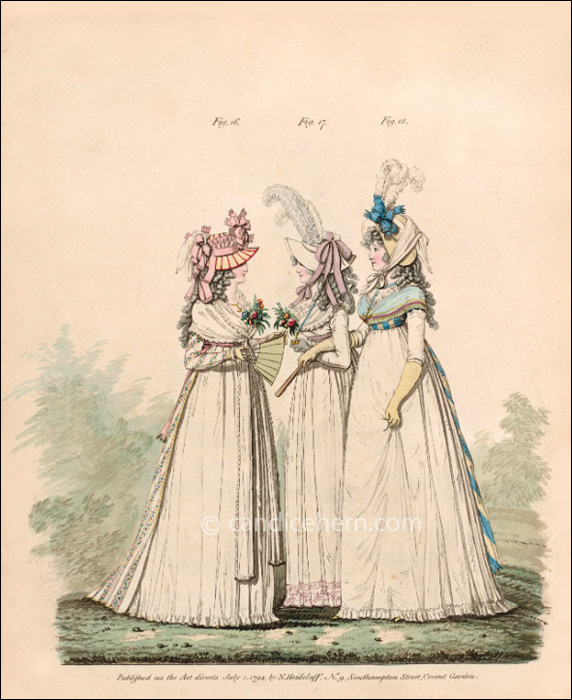
The narrower white muslin skirts without hoops began to be worn in the mid-1780s (famously seen in Vigée Le Brun’s portrait of Queen Marie Antoinette in 1783). But the higher waistline wasn’t widely accepted until around 1793. The skirts grow much narrower in the early years of the 19th century, as the Regency silhouette becomes the norm. Here, the skirts are gathered all around, with more fullness in the back.
The figure on the left is described as wearing “a plain night gown.” This does not refer to a garment worn to bed. At this time, “night gown” meant a comfortable dress, often of Indian muslin, worn around the house or for very informal occasions, rather like the Morning Dresses worn during the Regency. In fact, the text for this print is titled “Morning Dresses.”
All three ladies are shown wearing gold anchors around their necks. (And the anchors are painted in bright metallic gold paint.) I am not sure what the anchors represent, although it is possible they commemorate the Glorious First of June when the British fleet defeated the French fleet in the North Atlantic on June 1, 1794.
The print is described in the magazine as follows:
“FIG. XVI. Straw hat with carnation-coloured stripes, trimmed with rose-coloured ribands; a white gauze handkerchief with a lilac border, placed in the bow behind. The hair frizzed in light curls, and hanging down in ringlets behind. Lawn petticoat, with a narrow flounce. Plain night gown of chintz with long sleeves, the train bound with yellow riband. Plain lawn handkerchief. Rose-coloured sash. White lawn cloak, trimmed with lace. A gold anchor suspended by a gold chain round the neck. Yellow shoes and gloves.
“FIG. XVII. Plain white chip hat, trimmed with lilac ribands tied round the crown and forming at the left side an easy bow. One white and one lilac-coloured feather placed near the front on the left side. The hat tied under the chin with a lilac riband. The hair lightly frizzed. The chignon turned up plain, the end returned in ringlets. Round gown of lawn, with a narrow border embroidered in lilac. Long sleeves; a plaiting of lace round the neck. Plain handkerchief put within the gown: a high tucker, trimmed with a narrow edging. Lilac-coloured sash. A gold anchor suspended by a blue riband over the shoulders. Light blue shoes. Grey gloves.
“FIG. XVIII. Straw-coloured gipsy hat, trimmed with light blue ribbands, forming a large bow in the front, tied under the chin with a white lawn handkerchief with an embroidered border; two white ostrich feathers placed on the right side. Round gown of muslin, flounced at the bottom. Short sleeves. Plain white handkerchief, over it a blue silk one with a striped border. Blue and yellow striped sash. A gold anchor suspended by a blue riband round the neck. Yellow shoes and gloves.”