Le Beau Monde, July 1808.
“Half Full Dresses for July 1808.”
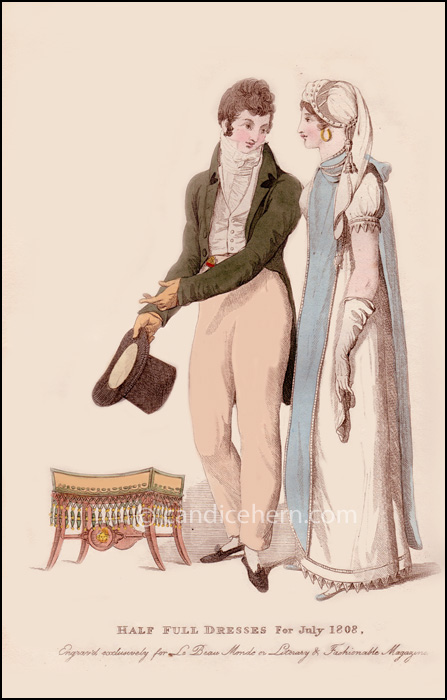
Half Dress for both men and women was dressier than day wear, appropriate for late afternoon and evening events that did not require formal Full Dress. Though these terms are never defined in the ladies’ magazines, we have to assume that readers understood them. Half Full Dress, is something of a puzzle, but seems to be a step up from Half Dress, but not fancy or luxurious enough for Full Dress. For example, a gentleman at this time would likely wear breeches and stockings with Full Dress, not trousers. And a lady in Full Dress would certainly wear jewelry finer and more expensive than simple good hoop earrings.
The section on General Observations on Ladies’ Dresses for July states:
“From the arrangements of the season the half dress is nearly as rich in lace and ornament as the full dress of the winter evenings. This naturally arises from the fashionable world being now on the wing for the different watering places, and other summer resorts …”
As is typical of this magazine, the female’s dress is described in detail, whereas the gentleman’s ensemble is only briefly described, with most of the text reporting on current trends in gentlemen’s fashion.
The print is described in the magazine as follows:
“GENTLEMEN’S DRESSES. Fig. No. 1.–A grass-green coat with covered ot metal buttons: white dimity waistcoat; Nankin trowsers and stockings; shoes with strings. Single-breasted coats are by far the most proper and gentlemanly, although many continue to be lappelled. Light pepper and salt mixtures, or a sort of haresback mixture, with plain plated, or plated basket buttons, are equally fashionable; striped quilting waistcoats, single-breasted; and white corduroy breeches are worn with these coats.
“LADIES’ DRESSES. Fig. No. 2–HALF FULL DRESS.–A plain simple dress of India muslin, with an elegant vandyked trimming of lace round the bottom and sleeves, with a footing inserted above of the richest point lace. The dress is made a walking length, moderately long in the waist, with a full frock back, the front square with a mitreing of point inserted round the bottom. The sleeves are longer than formerly, made full, and gathered into a footing of point lace, to correspond with the bottom of the dress. The capuchin cloak if of sky blue sarsnet, edged with a rich footing of point lace, or of the new invented floss silk trimming. The Tyrolese cap is composed of white satin, lace, pearls, and gold net, with variegated tassels of gold and silver bullion, and twist intermixed. Gloves are white, and the shoes of light blue to match the cloak. Ear-rings, large gold hoops.”