Ackermann’s Repository of Arts, March 1816.
“Evening Dress.”
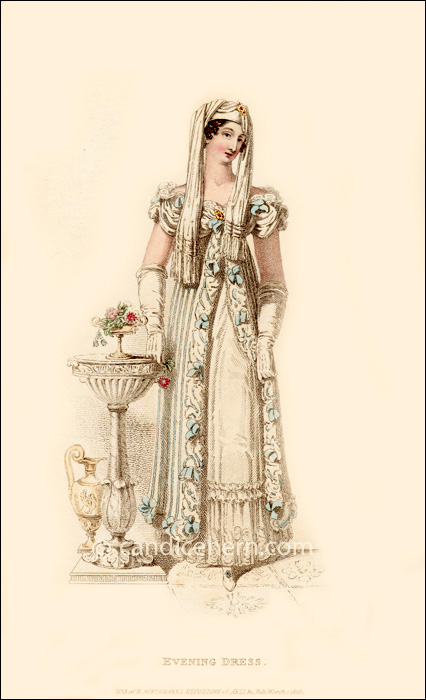
The model is described as wearing a ruby and pearl aigrette on her turban. Some sort of ornament is there, and it does appear to include rubies, but it is not an aigrette. The description also mentions a necklace, earrings, and bracelets also of rubies and pearls, but none of those items are to be seen in the print. However, a brooch is pinned to the bodice, identical to the one on the turban: a gold setting with rubies. Somewhere between the text and the artist/engraver, lines got crossed regarding the jewelry.
The blue and white trimming of the robe is, for some reason, not allowed to be described. Was it the modiste, Mrs. Gill, who refused to have it described? Though one would assume she would want it described, especially if it was exclusive to her salon. Or perhaps the unknown lady for whom the dress was made forbade its description so she could be the first to wear the elegant trimming? Who knows?
The print is described in the magazine as follows:
“White satin slip trimmed with a deep flounce of blond lace, set on full and finished by a double heading. The upper dress is a robe composed of striped French gauze, open in front; the waist is very short; and the body, which is made in a perfectly novel style, displays the contour of the shape to the utmost advantage. For the form of the sleeve, which is peculiarly elegant, we refer our readers to the print; as we are also obliged to do for the beautiful trimming, which goes round the robe; it is composed of novel materials, which we are not allowed to describe. Hair dressed much off the forehead, and low at the sides. Head-dress Circassian turban composed of French gauze; the ends, which depend from each side, are so disposed as to partly shade the neck; they are extremely rich and beautiful. The only ornament is a superb aigrette composed of pearls and rubies. This head-dress is well calculated for graceful and majestic belles, to whom it gives what the French term l’air imposant. Necklace, ear-rings, and bracelets, rubies intermixed with pearls. White satin slippers, and white kid gloves.
“Mrs. Gill of Cork-street, Burlington Gardens, has favored us with the original and elegantly fancied dresses given in our prints this month [including this one].”
In the General Observations on Fashion and Dress, it is lamented that British ladies still look to France for modes and materials of fashionable attire, though less so than previously. “We are convinced they would gradually decline in estimation if our London milliners would copy the example set them by Mrs. Gill, and, instead of adopting the Parisian fashions, have recourse to their own ingenuity and taste for new ones.”
And it goes on the sing the praises of the novelty and elegance of Mrs. Gill, whose fashions “always leave the most elegant selection from French costume very far behind indeed.”
Mrs. Gill, whose fashions had been seen in Ackermann’s Repository since 1812, surely paid for such blatant promotion.