
Prudence uses lace pins to keep her fichu in place.
Lace pins are so called because they were frequently used to confine a length of lace at the neckline or at the throat, or sometimes to attach drapery at the shoulder. It is interesting to note that although the term “pin” to mean “brooch” is an American custom, in England these little brooches were always referred to as “pins,” either lace pins or handkerchief pins, probably because their function was similar to that of a dress pin, to hold something in place, and was not merely ornamental.
Be aware that the images below are much enlarged. These pins are tiny! The captions beneath note the true size.
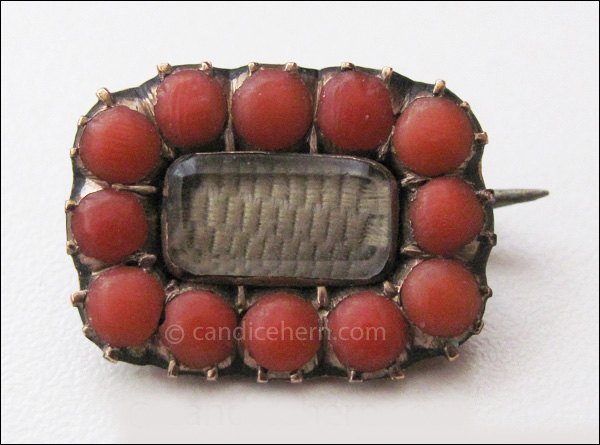
Figure 1: Tiny lace pin set with coral in gold, with very finely woven blond hair under the glass. Approximately ½” across. c1810.
Lace pins often have sentimental meaning, however, and are therefore frequently classified as sentimental jewelry. (Sentimental jewelry falls into two categories: the sentiment of love and the sentiment of grief.) Many of the small brooches shown in my articles on Georgian Hearts, Mourning Brooches, and Silhouette Jewelry were used as lace pins.
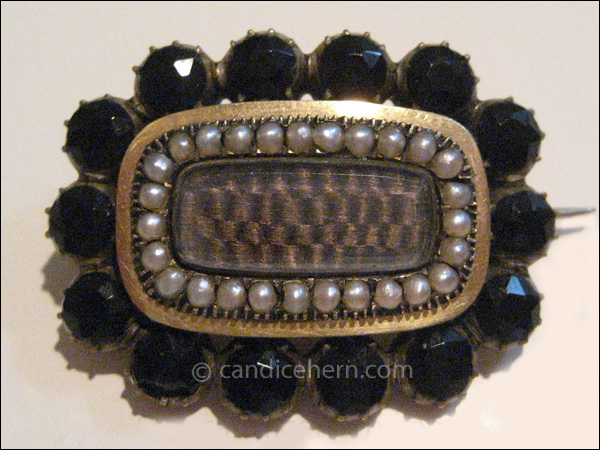
Figure 2: Lace pin set with faceted jet stones, a simple gold frame, and a surround of seed pearls, with finely woven brown hair under the glass. Approximately 1 ¼” across. c1820. The black jet stones and seed pearls indicate this was a mourning piece.
This collection is comprised of lace pins that include a central panel of woven hair under glass. The glass-enclosed panel is generally surrounded by stones or chased metal. The hair would have belonged to a loved one— a child, a spouse, a lover, a parent — and in some cases was simply a token of affection, ie a mother wearing a pin set with her child’s hair. But a great many lace pains were mourning pieces, with woven hair from the deceased loved one, and an inscription on the reverse with the loved one’s name, age, and date of death. (Figures 5 and 8 have such inscriptions.)
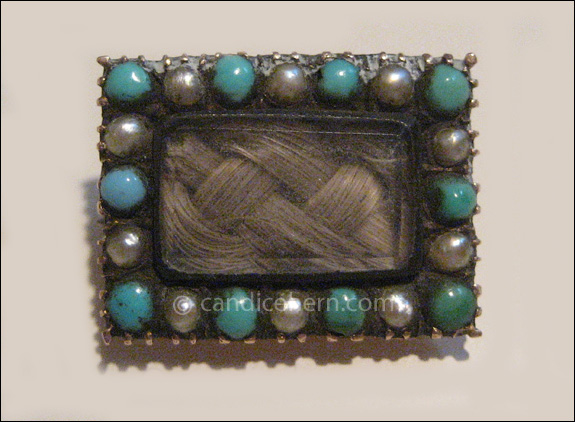
Figure 3: Tiny lace pin set within a frame of alternating seed pearls and turquoise, with simply woven blond hair under the glass. Approximately ½” across. c1810. Turquoise was sometimes used in mourning jewelry, so the combination here with seed pearls likely indicates a mourning piece.
When there is no inscription, it is almost impossible to know if the pin is a mourning piece or a love token. Sometimes the surrounding stones give a clue. Jet, French jet (which is not true jet but black glass), onyx, or other black stones almost always represent mourning. (See Figures 2 and 8.) Turquoise can also signify mourning. (See Figure 3.) Seed pearls often represent tears (see Figures 2, 3, and 5) and garnets often symbolized romantic love (see Figure 7).
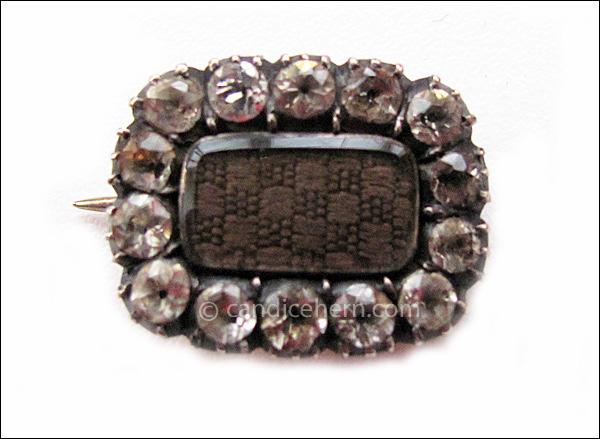
Figure 4: Tiny lace pin set with paste stones in gold, and intricately woven brown hair under the glass. Approximately ½” across. c1815.
Hair had been used in jewelry for centuries, and was thought to contain the “essence” of the person it came from. Because it is virtually imperishable, hair became symbolic of immortality, and keeping a lock of a loved one’s hair was a way of preserving that essence. Bracelets woven of hair are mentioned as early as the 17th century. During the later decades of that century, woven hair or hair laid in straight strands was used as a background for sentimental motifs or initials in gold wire, primarily in slides and lockets.
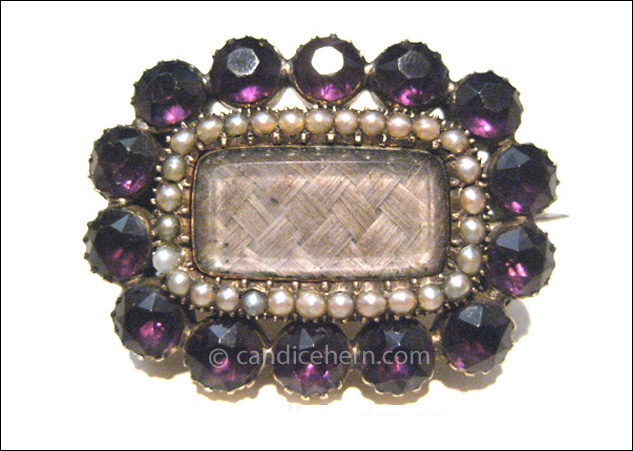
Figure 5: Lace pin set with amethyst and seed pearls, the glass center holding basket-woven blond hair. Approximately 1 ¼” across. Amethyst in mourning jewelry represents remembrance, and seed pearls represent tears. The reverse inscribed:
Mary Penstone / died 16 May 1821 / aged 22In the Georgian, Regency, and Victorian eras hair-work took on the qualities of a shrine to the loved one. As seen in my article on Mourning Brooches, bits of chopped or dissolved hair were often incorporated into scenes or symbols. Lockets frequently included a back panel of glass under which a curled lock of hair was enclosed. Weaving hair into elaborate patterns came into vogue in the mid-18th century, when hair-woven bracelets and watch chains became increasingly popular, and reached its height of popularity in the mid-19th century when every sort of jewelry was made from woven hair, including earrings and necklaces.
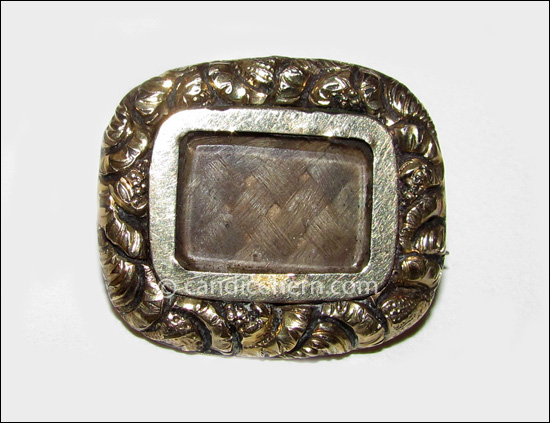
Figure 6: Tiny lace pin with chased gold frame, and basket-woven hair under the glass. Approximately ½” across. c1810.
Because hair was such an integral part of mourning jewelry, many people set aside a quantity of hair to be given to their loved ones. In 1793, as the elderly Lady Bute was having her hair cut, she said to her maid, “Keep this for my daughters. They will be glad of it, and very good hair it is for a woman of near seventy-seven.” During the Victorian era, most ladies kept a hair receiver on their dressing table. Hair was removed from her brush and stored in the receiver, and could later be used for jewelry.
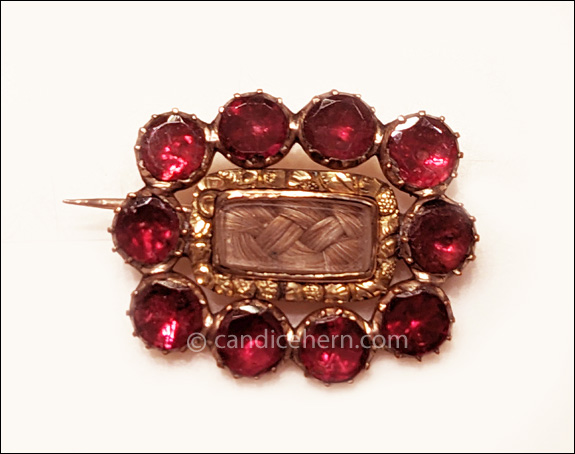
Figure 7: Tiny lace pin with garnets surrounding chased gold, with woven hair in the center under glass. ¾” across. c1810-1815.
The flat-woven hair that had once served only as a background became the centerpiece of the small handkerchief pins, or lace pins, that became popular in the late 18th and early 19th centuries, and which are represented here. Hair from a loved one could be taken to a jeweler to be woven and plaited in a manner similar to making bobbin lace, and it was then mounted under glass with a gold or gemstone surround. Some of the weaving in the lace pins in this collection is so fine and intricate that one must assume it was done professionally. (See especially Figure 4, which is only ½” across, making the intricate pattern of the weave even more remarkable.) But it was just as common for the hair to be home-woven and placed in pre-purchased brooch frames.
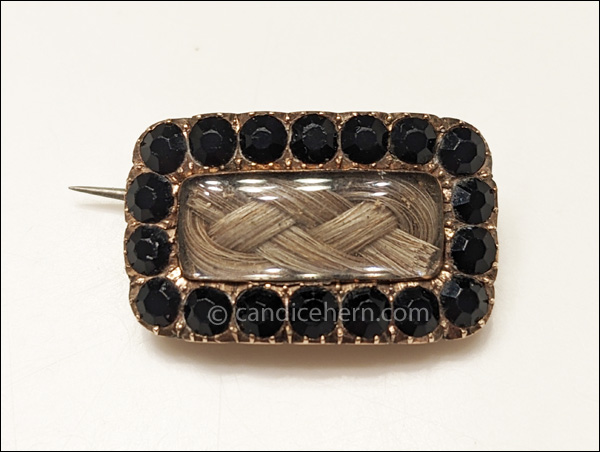
Figure 8: Tiny lace pin set with faceted jet stones set in gold, with woven blond hair in the center under glass. 1″ across. The jet stones mark this as a mourning piece. The reverse inscribed:
Henry Fawcett / died 15 February 1816 / Aged 53
Mr. Fawcett was a member of Parliament for Carlisle at the time of his death.The little lace pins seen in this collection are of the early type most popular during the Regency. Similar pins continued to be worn, in various forms, through the end of the 19th century. During the Regency years, the pins were quite small and delicate, some no bigger than a half inch. They became larger and heavier during the Victorian years.
For more information on lace pins and hair jewelry, see the following sources:
- J. Anderson Black, The Story of Jewelry, William Morrow and Co., 1974.
- Shirley Bury, Jewellery, the International Era, Volume I: 1789-1861, Antique Collectors Club, 1991.
- Shirley Bury, Sentimental Jewellery, Stemmer House Publications, 1985.
- Mona Curran, Collecting Antique Jewellery, Emerson Books, 1963.
- Maureen DeLorne, Mourning Art and Jewelry, Schiffer, 2004.
- Ann Louise Luthi , Sentimental Jewellery: Antique Jewels of Love and Sorrow , Shire Books, 1998.
- Geoffrey C. Munn, The Triumph of Love: Jewelry 1530-1930, Thames and Hudson, 1993.
- Clare Phillips, Jewelry, from Antiquity to Present, Thames and Hudson, 1996.
- Clare Phillips, Jewels and Jewellery, Victoria and Albert Publications, 2000.
- Diana Scarisbrick, Jewellery in Britain 1066-1837, Michael Russel Ltd, 1994.