La Belle Assemblée, October 1811.
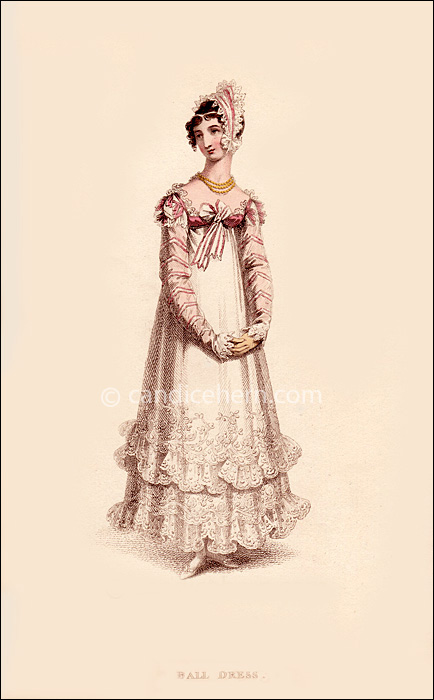
“Ball Dress.”

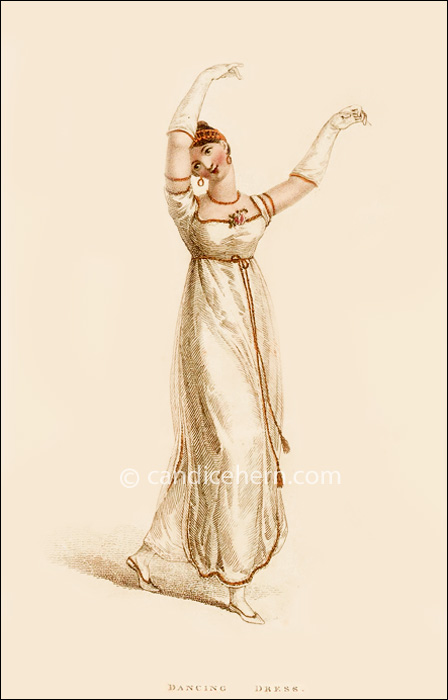
Often when we see movement in Ball Dress prints, they have been copied from a print in the Journal de Dames et des Modes of Paris. But I can find no prints in that publication that match this one, so this print must have been a rare example of an original British print showing a dancing dress in movement.
Prints from 1811 in this magazine and in Ackermann’s often show a lower waist than we see in 1810 or 1812 and beyond. This is especially true of evening wear. If it was just a passing fad in 1811, it did not last. Waistlines continued to creep upward through 1820, when they finally, slowly began to go down again, reaching the natural waist by the mid 1820s.
The artist has given a lovely suggestion of the transparency of the over-dress. He, or she, has also given us an excellent example of a fillet.
The print is described in the magazine as follows:
“A fancy dress of undressed white crape, worn over a satin slip; the waist of the dress in the bodice form, scolloped and bound with pink satin ribband; the bottom of the dressed scolloped in a similar manner, and caught up with small bunches of artificial flowers of an increased size. The hem of the petticoat trimmed with twisted satin and beads. Short Spanish sleeves composed of satin and lace; the back and shoulders of the dress trimmed with vandyke; a bouquet of artificial flowers worn much on one side. The hair ornamented with a fillet of twisted satin and pearls, placed twice round the head, and left to fall in a tassel, finished with beads. Pearl necklaces and ear-rings. White kid gloves and shoes, with small pink and silver roses.”