Finger purses had been around for centuries, but experienced a renewed popularity at the end of the 18th century. They were very tiny and could hold only a coin or two, but typically left the hands free when an attached ring was slipped on a finger. Those types of purses were called finger-ring purses. They disappeared by the second decade of the 19th century, only to reappear with even greater popularity in the late 19th century through the early 20th century.
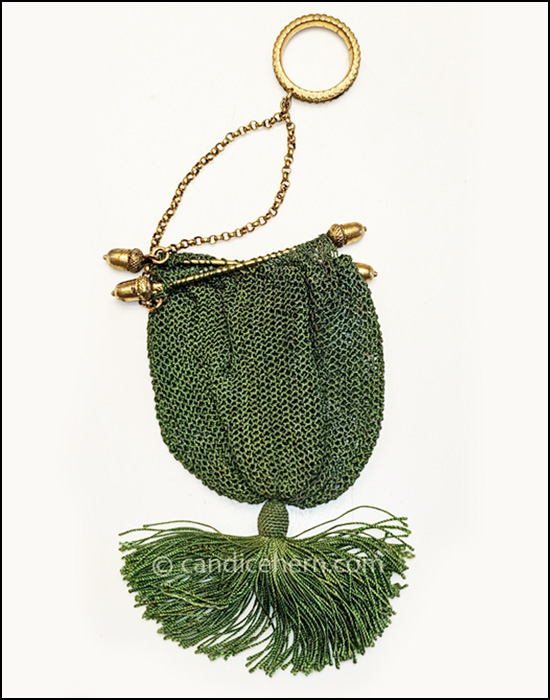
Figure 1: Finger-ring purse of finely netted green silk. Gilt opening bars with acorns at the ends are attached to a gilt finger-ring. Silk is gathered and tied into a tassel at the bottom of the purse. 2″ long, from bar to tassel knot. c1795.
Most finger ring purses were hand-made, either knitted, netted, or crocheted. Kits could be purchased with the ring and chain, as well as two metal bars that would be crossed to keep the tiny purse closed.
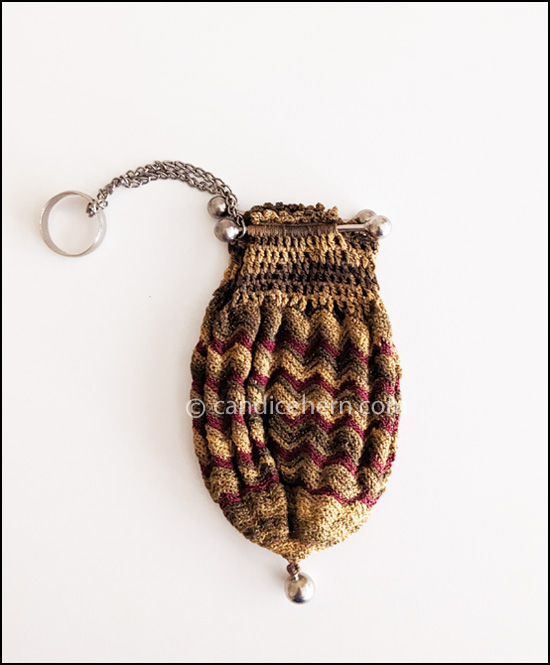
Figure 2: Small knitted tubular finger-ring purse with a flamestitch pattern highlighted with gold metallic thread. Sterling opening bars attached to a sterling finger-ring, and a sterling ball hangs from the bottom of the purse. 3″ long, from bar to tassel bead. c1800.
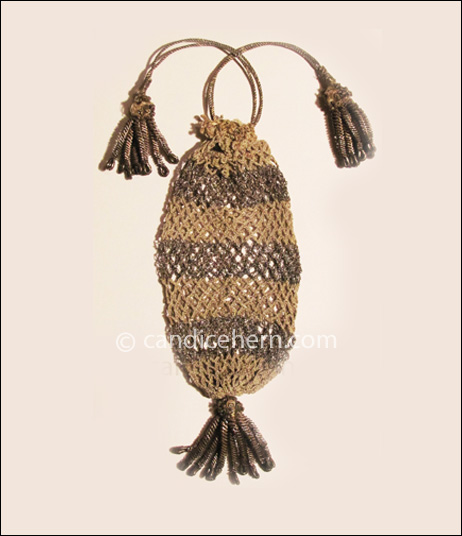
Another type of finger purse was simply a tiny purse with a long handle that could be wrapped around a finger. (See Figure 3.) Though these purses might also have been made to attach to a chatelaine, most chatelain purses have metal chains. The thin cord handle in the tiny purse in Figure 3 suggests it was more likely a variation of the finger purse.
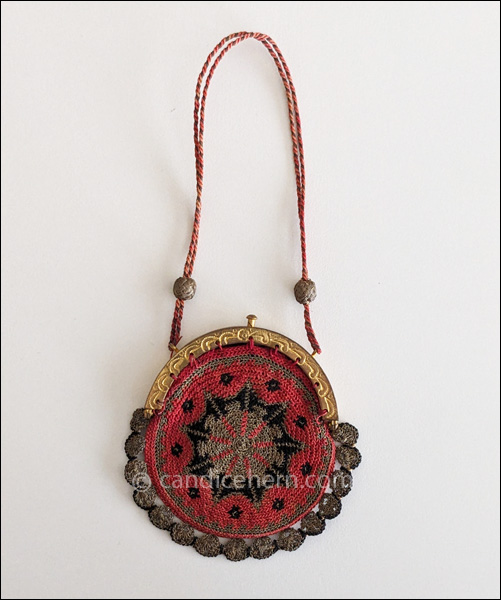
Figure 3: Tiny purse knitted in a circular pattern of red, black, and silver, the bottom trimmed with knitted silver circles. Pinchbeck frame. Twisted cord handle adorned with two silver balls. Just under 2″ without the handle. c1810-1815.
Based on the few extant examples in museums, and the scarcity of them in today’s antique market, we can assume that finger purses were not popular during the Regency. The coin purses seen in my Collections (see Knitted and Netted Purses and Beaded Sovereign Purses) likely served a better purpose.