Fashions of London and Paris, November 1800.
“Head Dresses.”

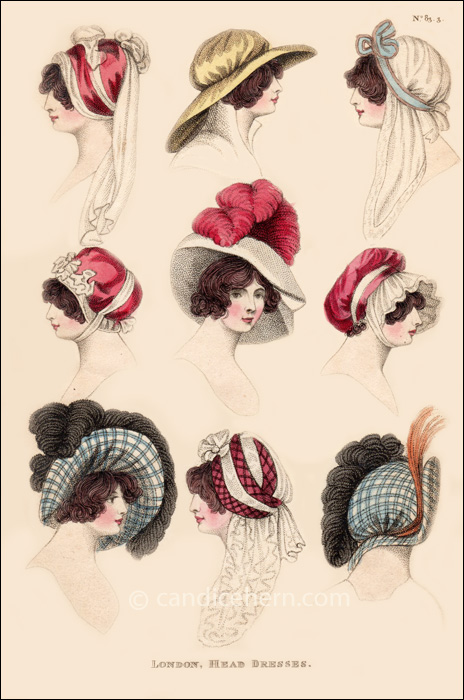
When a head dress is called a hat or bonnet, it generally means it has a brim, as seen in Figure 1 and Figure 5 (brims were very brief at this time). When a head dress is called a cap, it generally means there is no brim or stiffened crown, but is only composed of fabric, as seen in Figures 2, 3, 8, and 9. A turban is usually made of fabric wrapped around the head. Both Figures 4 and 7 are called turbans, but they look more like caps to me, especially Figure 4. And Figure 6 is called a hat, but shows no brim, so I would think it was more correctly a cap.
This is all to say that the naming of head dresses at this time was somewhat inconsistent.
In general, brimmed bonnets, caps, and turbans were kept very close to the head at this time. Crowns and brims will explode in years to come.
The print is described in the magazine as follows:
Fig. 1. Hat of white raised velvet, turned up in front, and ornamented with white ostrich feathers.
“Fig. 2. Cap of white lace, ornamented with gold beads; a down feather in the front.
“Fig. 3. Cap of hwite crape, trimmed with lace; bows of lilac, and black ribbon behind, and on the left side.
“Fig. 4. Turban of white raised velvet, trimmed with cocquelicot ribbon; roses in front.
“Fig. 5. Bonnet of black raised velvet, trimmed with black ribbon; black feather in front.
“Fig. 6. Hat of velvet, trimmed with elastic blue velvet; blue feather in front, and a bow behind.
“Fig. 7. Circassian turban, of white crape, or sattin, trimmed with gold trimming; white ostrich feather in front.
“Fig. 8. Cap of white crape over pink silk, ornamented with ribbon; a deep lace border.
“Fig. 9. Cap if pink crape, trimmed with black lace, and pink ribbon; red roses in front.”